 |  |
Market Outlook
|
AS ON 30TH JUNE 2026
|


Global Macro Developments: Global markets navigated a mixed backdrop in June 2026. Risk appetite improved in parts
of emerging markets as lower oil prices and discussion around the reopening of the Strait of Hormuz eased some macro
pressure, but leadership remained narrow and still centered on technology-heavy markets. Global equities fell ~0.9%
overall, with strength concentrated in India (+1.2%) and Taiwan (+1.0%), while China (-7.6%) and Africa (-6.8%) lagged. In the
US, at its June 16–17 meeting, the Fed left policy restrictive and revised its projections toward higher inflation and a higher
expected policy rate than in March. Inflation remained above the Fed’s 2% target.
Global Equities: Global equity performance in June remained selective rather than broad-based. In US dollar terms, MSCI India rose 1.2% for the month, ahead of Emerging Markets and Asia Pacific ex Japan, both of which declined 1.7%. Taiwan rose 1.0%, Korea rose 0.3%, and the Euro area rose 0.8%, while the US fell 1.0%, World declined 0.9%, Brazil fell 3.3%, South Africa fell 6.8%, and China declined 7.6%. The broader message remained that market gains continue to be concentrated in a relatively small set of themes and geographies.
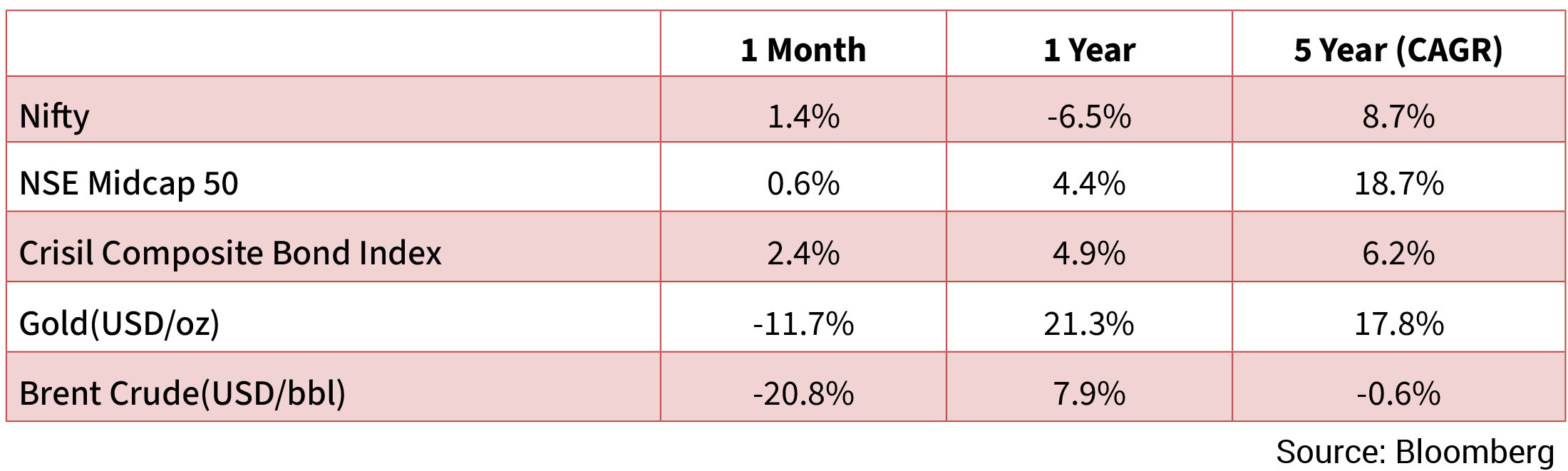
Commodities: Commodities stayed central to the macro narrative. Brent crude ended June at USD 72.9/bbl, sharply below the USD 92.1/bbl level at the end of May. The fall in oil eased inflation concerns for oil-importing economies such as India and supported bond market sentiment.
India Macro Developments: India’s macro picture remained constructive, though not without pockets of pressure. Headline CPI rose to 3.9% YoY in May from 3.5% in April, broadly in line with expectations, while food inflation increased to 4.5% from 4.0% led by vegetables, milk, and eggs. GDP growth for 1QFY27 came in at 7.8% YoY, easing modestly from 8.0% in 4QFY26 but still above expectations. Growth was broad-based, although manufacturing slowed sharply to 7.3% from 12.8%. Industrial production under the revised series also surprised positively, rising to 4.9% YoY in April from 3.2% in March.
Indian Equities: Indian equities performed better in June after a softer May. The Nifty 50 rose 1.4% and closed the month at 23,866, while large caps gained 0.7% and trailed small and mid-caps. In US dollar terms, MSCI India returned 1.2% for the month. Sector leadership shifted meaningfully: Real Estate (+6.8%), Financials (+5.4%) and Healthcare (+5.3%) were the best-performing sectors, while IT (-11.2%), Materials (-5.1%) and Utilities (-4.5%) lagged.
Currency Movements: The INR appreciated 0.4% in June and ended the month at 94.67/USD. Even after the monthly gain, the currency remained 9.4% weaker over the past year. Dollar strength persisted, with the DXY rising 2.3% in June to 101.2. It was also noted that the RBI sold around USD 8.8 billion of forex reserves in the prior four weeks, underscoring continued management of external pressures even as lower oil prices offered some near-term relief.
Bond Yields: Indian government bonds rallied in June. The benchmark 10-year G-Sec yield closed at 6.75%, down 25 bps over the month, as falling crude prices and easing inflation concerns supported duration. The US 10-year Treasury yield, by contrast, ended at 4.47%, up 3 bps over the month. Domestic bond markets remain sensitive to food inflation risks, currency moves and developments in West Asia, but the June move was clearly aided by softer oil and a calmer external backdrop.
Global Equities: Global equity performance in June remained selective rather than broad-based. In US dollar terms, MSCI India rose 1.2% for the month, ahead of Emerging Markets and Asia Pacific ex Japan, both of which declined 1.7%. Taiwan rose 1.0%, Korea rose 0.3%, and the Euro area rose 0.8%, while the US fell 1.0%, World declined 0.9%, Brazil fell 3.3%, South Africa fell 6.8%, and China declined 7.6%. The broader message remained that market gains continue to be concentrated in a relatively small set of themes and geographies.
Commodities: Commodities stayed central to the macro narrative. Brent crude ended June at USD 72.9/bbl, sharply below the USD 92.1/bbl level at the end of May. The fall in oil eased inflation concerns for oil-importing economies such as India and supported bond market sentiment.
India Macro Developments: India’s macro picture remained constructive, though not without pockets of pressure. Headline CPI rose to 3.9% YoY in May from 3.5% in April, broadly in line with expectations, while food inflation increased to 4.5% from 4.0% led by vegetables, milk, and eggs. GDP growth for 1QFY27 came in at 7.8% YoY, easing modestly from 8.0% in 4QFY26 but still above expectations. Growth was broad-based, although manufacturing slowed sharply to 7.3% from 12.8%. Industrial production under the revised series also surprised positively, rising to 4.9% YoY in April from 3.2% in March.
Indian Equities: Indian equities performed better in June after a softer May. The Nifty 50 rose 1.4% and closed the month at 23,866, while large caps gained 0.7% and trailed small and mid-caps. In US dollar terms, MSCI India returned 1.2% for the month. Sector leadership shifted meaningfully: Real Estate (+6.8%), Financials (+5.4%) and Healthcare (+5.3%) were the best-performing sectors, while IT (-11.2%), Materials (-5.1%) and Utilities (-4.5%) lagged.
Currency Movements: The INR appreciated 0.4% in June and ended the month at 94.67/USD. Even after the monthly gain, the currency remained 9.4% weaker over the past year. Dollar strength persisted, with the DXY rising 2.3% in June to 101.2. It was also noted that the RBI sold around USD 8.8 billion of forex reserves in the prior four weeks, underscoring continued management of external pressures even as lower oil prices offered some near-term relief.
Bond Yields: Indian government bonds rallied in June. The benchmark 10-year G-Sec yield closed at 6.75%, down 25 bps over the month, as falling crude prices and easing inflation concerns supported duration. The US 10-year Treasury yield, by contrast, ended at 4.47%, up 3 bps over the month. Domestic bond markets remain sensitive to food inflation risks, currency moves and developments in West Asia, but the June move was clearly aided by softer oil and a calmer external backdrop.

Trade: India recorded a current account surplus of $7.1 billion, or 0.7% of GDP, in the fourth quarter (January–March) of FY26, aided by robust services exports and strong remittance inflows that helped offset a widening merchandise trade deficit, according to data released by the Reserve Bank of India (RBI). The surplus marks a sharp turnaround from the current account deficit of $13.2 billion (1.3% of GDP) reported in the preceding quarter. However, it was lower than the $13.7 billion surplus recorded in the corresponding quarter of FY25, reflecting pressure from a larger goods trade gap. India’s merchandise trade deficit widened to $83.4 billion in Q4 FY26 from $59.3 billion a year earlier as imports outpaced exports. The impact of the higher trade deficit was cushioned by strong performance in the services sector. Net services receipts rose to $60.4 billion during the quarter, up from $53.3 billion in the year-ago period, driven largely by growth in computer services and other business services exports. Remittances also continued to provide significant support to the external account. On the capital account side, foreign direct investment (FDI) inflows improved, with net inflows rising to $4.2 billion in Q4 FY26 from $0.4 billion a year earlier. Foreign portfolio investors (FPIs), however, remained net sellers, pulling out $12 billion during the quarter compared with outflows of $5.9 billion in the corresponding period last year.
CPI: Headline CPI rose to 3.9% y/y in May, broadly in line with expectations and up from 3.5% in April. Food prices continued to be firm in May, in line with expectations. Food inflation increased to 4.5% y/y from 4.0% in April, driven by increases in vegetables, milk, and eggs. High-frequency indicators for June point to further strength in vegetable prices and warrant close monitoring given upside risks from the ongoing heatwave and El Niño.
RBI June 2026 Policy: The Reserve Bank of India (RBI) kept the repo rate unchanged at 5.25% and retained its neutral policy stance, citing heightened uncertainty from geopolitical tensions, elevated crude oil prices, and inflation risks. While acknowledging that the domestic economy remains resilient, the Monetary Policy Committee emphasized a data-dependent approach, balancing the need to support growth with its commitment to price stability. The RBI also highlighted risks from supply-chain disruptions and global financial market volatility, signaling that future policy actions will depend on the evolving inflation and growth outlook rather than follow a predetermined path.
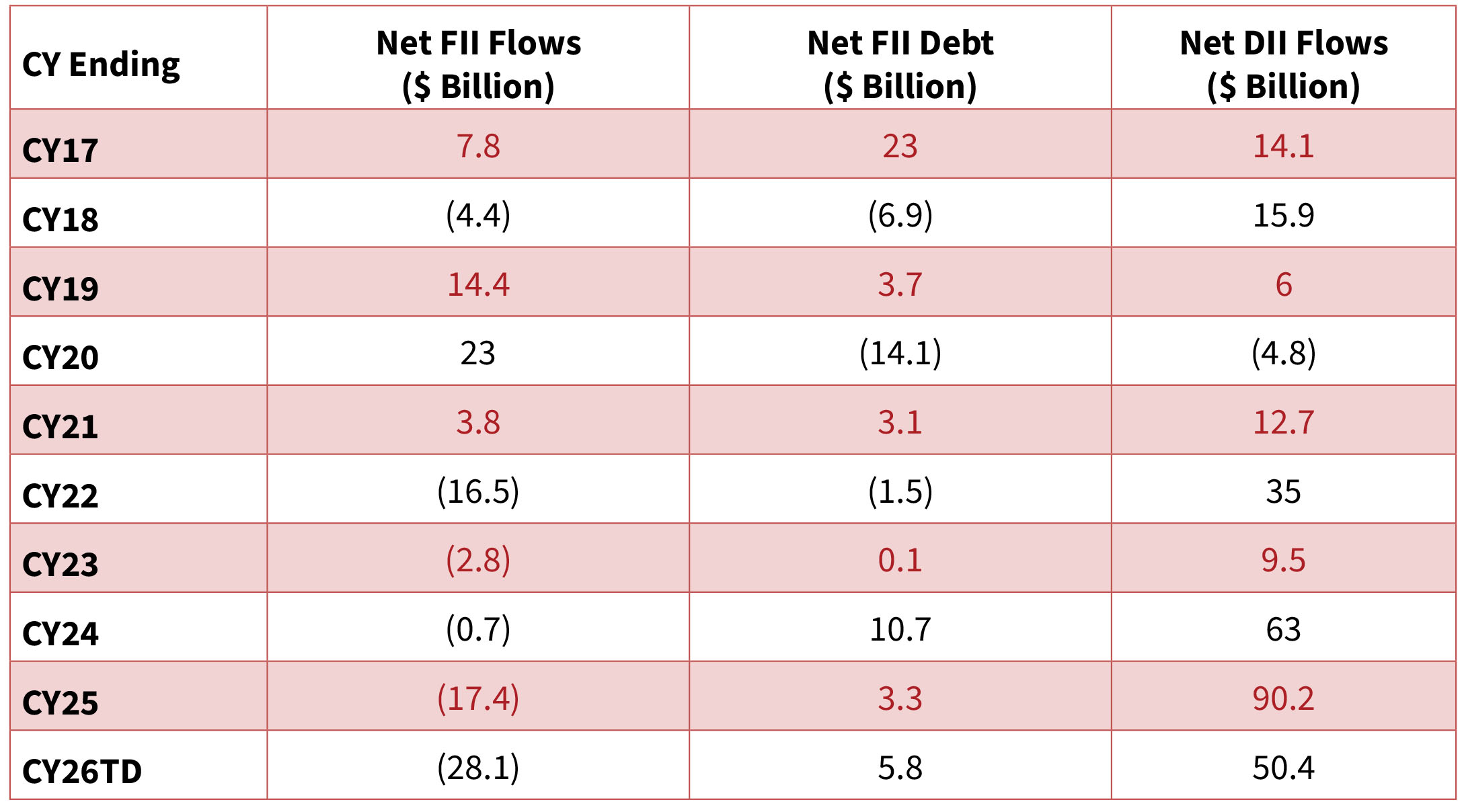
In June 2026, Foreign Institutional Investors (FIIs) maintained their selling trend, with outflows of $3.1bn in June (vs outflows
of $4.9bn in May). FIIs bought $5.3bn in the bond market in June (vs selling of $0.5bn in May) as the government exempted
government securities from LTCG and extended the tenors of bonds available under the FAR category. DIIs remained net
buyers for the 35th consecutive month. DIIs continued their inflows at $9.0bn ($8.7bn in May). Mutual funds bought $5.0bn
(vs $6.3bn in May). Insurance funds and Other FIs were net buyers too, with inflows of +$4.0bn (vs +$2.3bn). Retail increased
their inflows to $1.6bn in June (vs $0.3bn in May).