 |  |
Market Outlook
|
AS ON 31ST MARCH 2026
|


Global Macro Developments: The global macroeconomic backdrop in March was dominated by rising geopolitical uncertainty and a pronounced shift to risk-off sentiment. Heightened tensions in the Middle East – notably a conflict involving Iran – triggered a sharp spike in volatility (VIX) and a broad flight to safety across markets. This crisis has led to the largest disruption in energy supply since WWII, with oil output down over 10%, causing a massive surge in energy prices. Central banks in developed markets are weighing these new risks: the U.S. Federal Reserve kept policy rates unchanged at 3.50%-3.75% in March, with meeting minutes revealing growing divisions among FOMC members on the future rate path. In Japan, soft growth and muted inflation have cast doubt on further rate hikes, even as concerns over fiscal deterioration exert upward pressure on long-term Japanese bond yields. Overall, the stagflationary impulse from war-driven commodity shocks and tighter financial conditions is expected to weigh on global economic activity in coming quarters. Despite the potential for a tactical relief rally if a geopolitical resolution is reached, markets remain skittish, and positioning has become a key driver of short-term performance.
Global Equities:After strong gains early in the year, global equity markets reversed course sharply in March. The MSCI All- Country World Index sank approximately –9% for the month as investors de-risked. Developed Markets (DM) saw steep losses: U.S. equities fell about –7.7% in March, while European stocks tumbled –11% amid growth fears. Emerging Markets (EM) were hit even harder, dropping –13.5% in USD terms, as rising U.S. yields, a stronger dollar, and concerns over commoditydriven inflation led to broad outflows from risk assets. Asian markets bore the brunt of the sell-off: the MSCI Asia Pacific ex- Japan index plunged –13.4% in March. Markets like South Korea (-25.4% in March) and South Africa (-20.0%) also saw sharp corrections, partly retracing their strong year-to-date rallies.
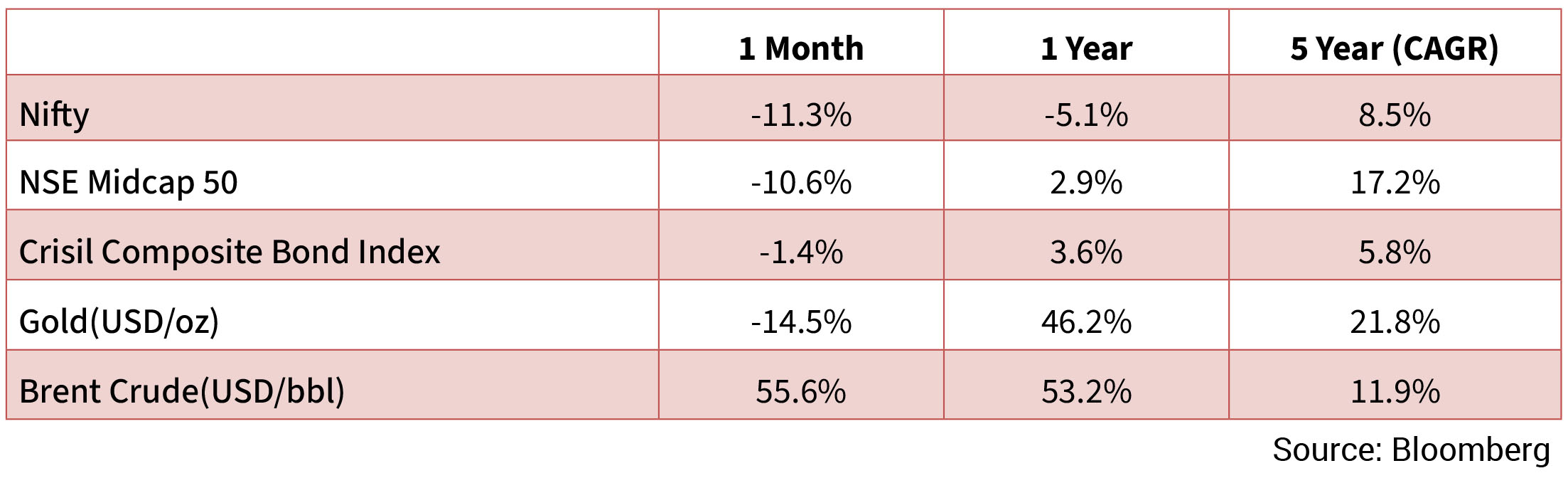
Commodities:Commodity markets experienced extreme volatility in March, led by energy prices. Oil surged on supply fears – Brent crude spiked from ~$72.5 at end-February to about $113.6/barrel by late March, a staggering ~56% monthly jump. This surge came as the war in the Middle East/Iran curtailed output, leading to the sharpest supply shock in decades. Elevated oil prices have revived global inflationary risks, particularly for oil-importing nations like India. In metals, price action was mixed – gold remained near record highs after its spectacular rally in February and continued to find support in March as investors sought safe-haven assets. Meanwhile, base metals faced two-way pressures: on one hand, potential supply disruptions supported prices, but on the other, slowing demand expectations (especially from China) kept gains in check.
India Macro Developments:Despite global headwinds, India’s domestic economy entered 2026 on a relatively strong footing, though new challenges have emerged. By late March the oil price spike and war-related uncertainty introduced downside risks to India’s macro trajectory. Surging crude prices threaten to widen the trade deficit, fuel inflation, and strain the fiscal balance. The government acted swiftly to mitigate the impact: it announced a ₹10/liter cut in excise duties on petrol and diesel to prevent retail fuel prices from rising in the near term. This move supports state-run oil marketing companies (OMCs) that were absorbing losses from selling fuel below cost. Each ₹1/liter excise cut costs ~₹175 billion in annual revenue; accordingly, the ₹10 cut equates to a roughly ₹1.75 trillion revenue loss (about 0.5% of GDP) over a year. This tax relief will help contain inflation and support consumers, but it adds pressure to the FY2026-27 fiscal deficit target of 4.3% of GDP by reducing government revenues. Potential upside risks to subsidy burdens (e.g. higher fertilizer subsidy needs) further threaten the fiscal math. On the positive side, the government has some buffers that could offset these hits: an Economic Stabilization Fund (₹570 billion infused in FY2025-26) is available for shock absorption, and non-tax revenues (like RBI dividends) might exceed conservative budget estimates – especially since a weaker rupee could boost the central bank’s profits on its dollar reserves. Central government announced Gsec gross borrowings of Rs 8.2tn in H1FY27 which is 51% of the total FY27BE gross Gsec borrowings, lower against estimates. Borrowing mix in the longer tenor was reduced from 30% to 25% while short term borrowing was increased. Borrowing was also announced for Q1FY27 through T-bill at Rs 2.88tn.
Indian Equities: Indian equity markets plunged in March, ending the fiscal year on a weak note. After a relatively flat February, March saw broad-based selling that pushed every sector into the red. The benchmark Nifty 50 index tumbled –11.3% during the month, closing at ~22,331 by end-March. Large-cap stocks dropped about –11.5% and slightly underperformed midand small-cap segments (which fell roughly 10.5%–11% each). Sector performance was uniformly negative. Only a few traditionally defensive or idiosyncratic sectors escaped with smaller declines – Utilities (-3.1%), Information Technology (-4.6%), and Healthcare (-4.7%) were the “least bad” sectors, each down under 5% in March.
Currency Movements: The Indian rupee came under intense pressure in March, reversing its brief February rally. The INR depreciated about –4.0% during March, closing near ₹94.8 per US$ at the end of the month. This marked one of the sharpest monthly declines for the rupee in recent years, bringing its 12-month depreciation to ~9.9% against the dollar. The U.S. Dollar Index (DXY), meanwhile, jumped +3.0% in March (to ~100.5) as investors sought safety – trimming the DXY’s own yearon- year decline to –3.6%. The RBI intervened heavily to curb disorderly currency moves, reportedly selling ~$25.3 billion of its foreign exchange reserves in the four weeks prior to end-March. RBI also issued a net exposure cap ($100mn) on banks’ INR positions as a lever to manage currency depreciation.
Bond Yields: Indian bond markets faced a sharp sell-off in late March as well. After easing in February, yields spiked on renewed inflation concerns and increased government borrowing. The 10-year benchmark G-Sec yield rose to ~7.04% by end-March. Indian bonds continue to be supported by benign domestic inflation (still near the lower end of the RBI’s target band) and strong demand from banks and long-term investors, but factors like rising global yields, a weaker rupee, and large fiscal borrowing plans have tilted the bias toward higher yields.
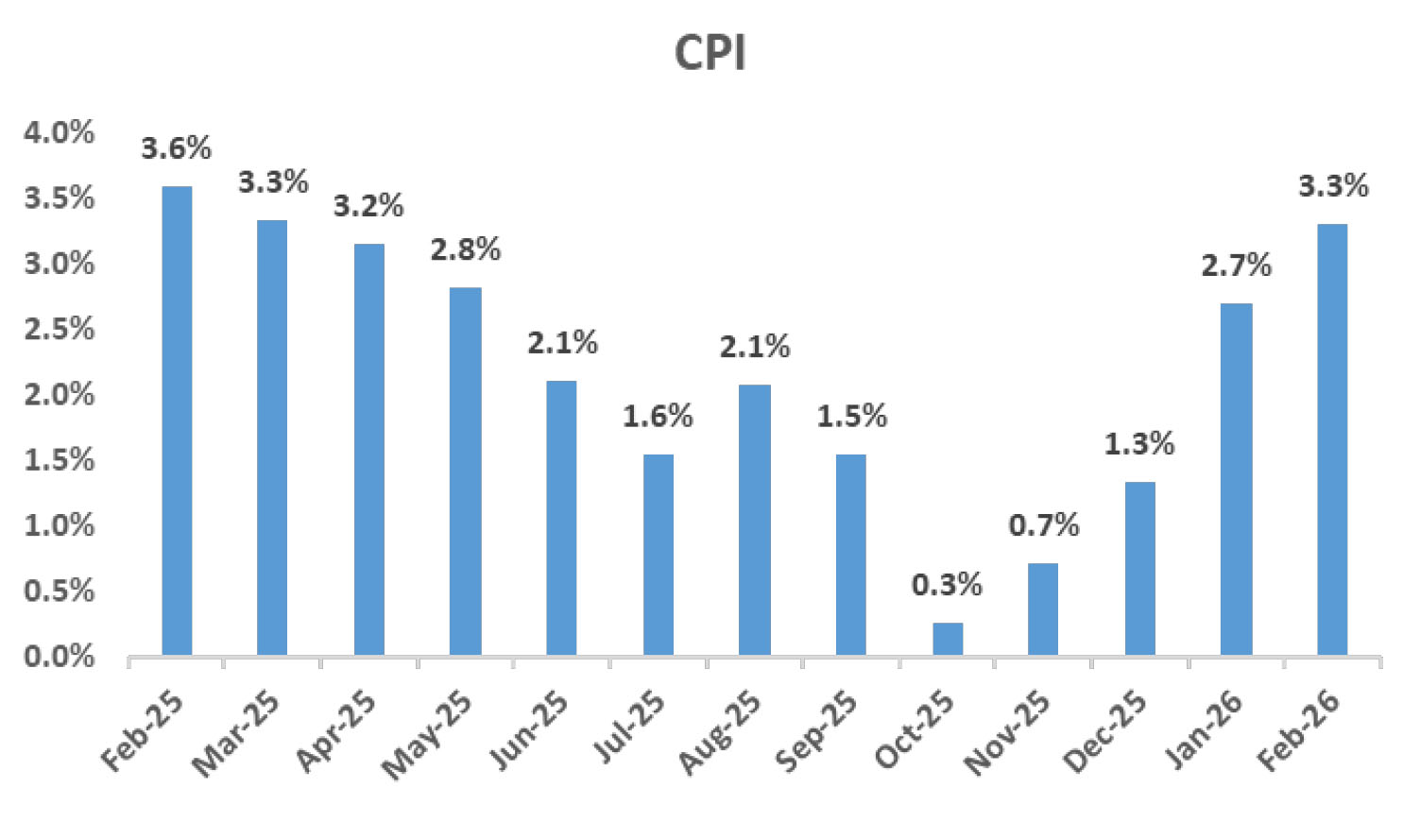
CPI: India’s inflation environment remains relatively tame but is trending up. Headline CPI came in at 3.2% YoY in February 2026, a notch above expectations mainly due to a rebound in food prices. Early signs in March pointed to further firming of food prices in line with seasonal patterns. Upside risks to the inflation trajectory have clearly increased due to the oil price shock. Meanwhile, Wholesale Price Index (WPI) inflation, which had crept up to 1.8% YoY in January, rose further to 2.1% in January on the back of higher commodity costs and waning favorable base effects. For now, core inflation remains subdued due to still-muted demand-pull pressures.
Trade:India’s external balances have come under stress from the twin forces of soaring import costs and ebbing capital inflows. The merchandise trade deficit narrowed in February to about $27.1 billion (from a record $34.7 bn in January). The improvement was mainly due to a pullback in imports of gold and oil from January’s extreme levels. Nonetheless, gold and silver imports remained very high at $9.1 bn in February (though down from January’s $14.1 bn spike). Imports rose 24.1% to $63.7bn. Whereas the merchandise exports fell for the first time in four months, by 0.8% YOY to $36.6bn.
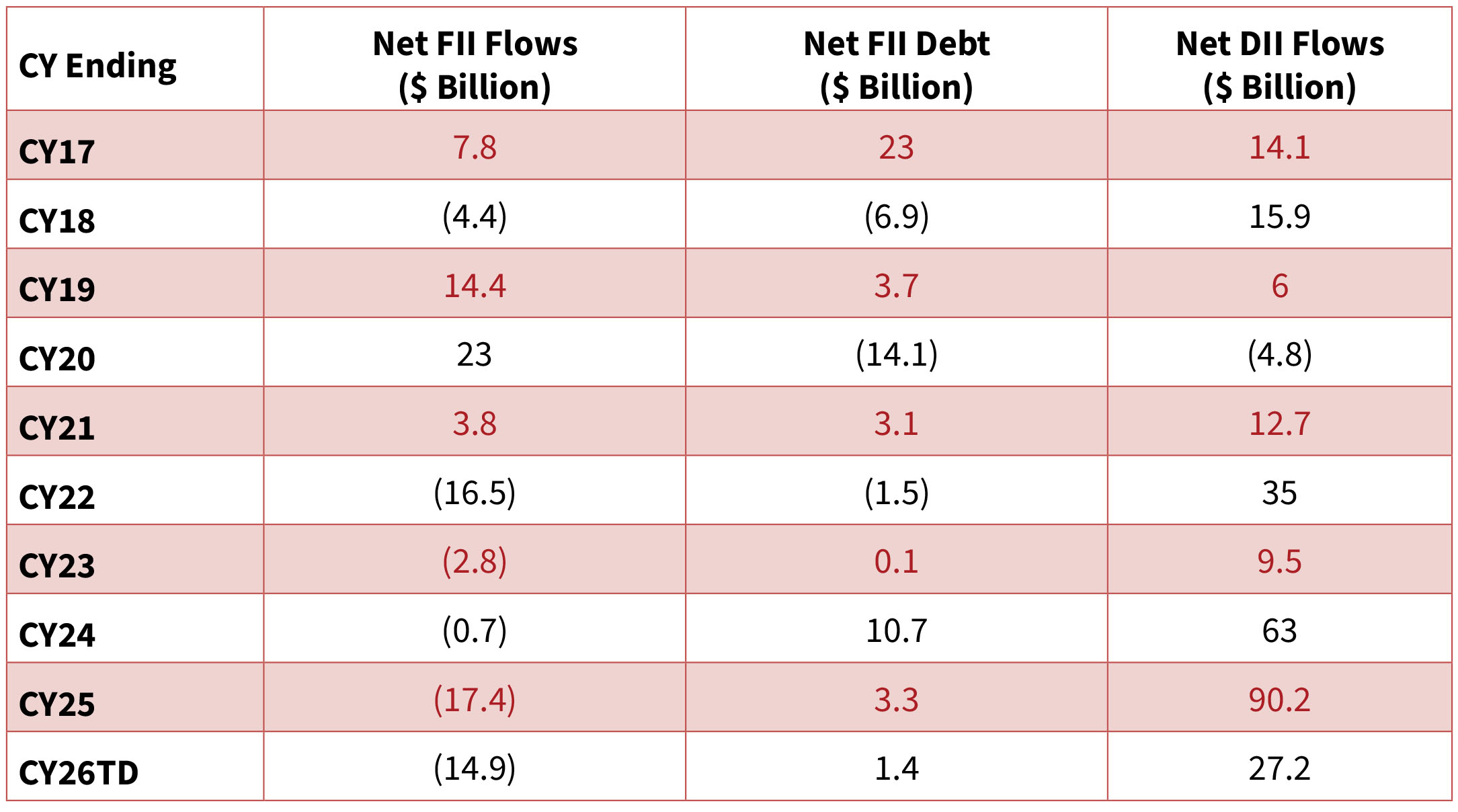
In March 2026, Foreign Institutional Investors (FIIs) turned net sellers, selling $13.3bn in equities (vs buying of $1.7bn in
February). FIIs also sold $0.7bn in the bond market in March (vs $1.3bn buying in Feb). DIIs remained net buyers for the 32nd
consecutive month with inflows of $15.4bn (vs Febraury’s $4.2bn), while mutual funds bought $8.1bn (vs buying of $1.3bn
in Feb). Insurance funds and other FIs also saw positive inflows, higher than the previous month. Retail investors turned
marginal buyers again, contributing $0.4bn, reversing Febraury’s outflow of $1.1bn.