 |  |
Market Outlook
|
AS ON 29TH MAY 2026
|


Global Macro Developments: In the month gone by, markets saw a more cautious market environment amid multiple
macro headwinds. While earlier optimism around a potential US–Iran ceasefire supported sentiment, persistent geopolitical
risks and continued global uncertainty weighed on markets. Global equities rose ~5.0% overall, with strength concentrated
in Korea (+35.2%) and Taiwan (+16.5%), while Brazil (-9.2%) and China (-3.4%) lagged. In the US, Fed commentary shifted
hawkish over the last two weeks. Initial jobless claims remained well contained, and core PCE rose 0.24% m/m (consensus:
0.3%), bringing the over-year-ago rate to 3.3%, ratifying the Fed’s shift away from an easing bias.
Global Equities: Global equities advanced in May, but market breadth remained limited, with gains largely driven by AIlinked sectors and select export-driven economies such as Korea and Taiwan. Earnings growth across emerging markets remained robust. The S&P 500 returned ~5%, and the MSCI Emerging Markets Index rose ~9.5%, led by Korea (+35.2%) and Taiwan (+16.5%). The rally gains were strongly skewed toward technology and AI-exposed segments.
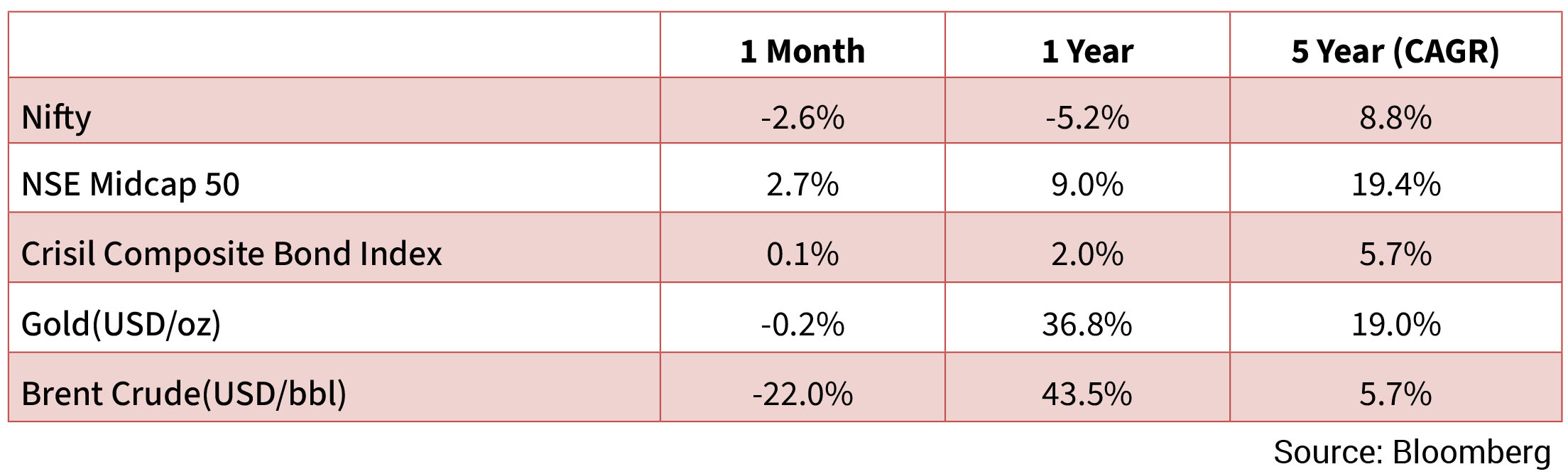
Commodities: Commodities remained a key macro transmission channel. Brent crude oil prices dropped by 19.3% in May, following a drop of 3.7% in Apr. Brent currently trades at $93.0, having ended at $114.0/bbl as of end- April.
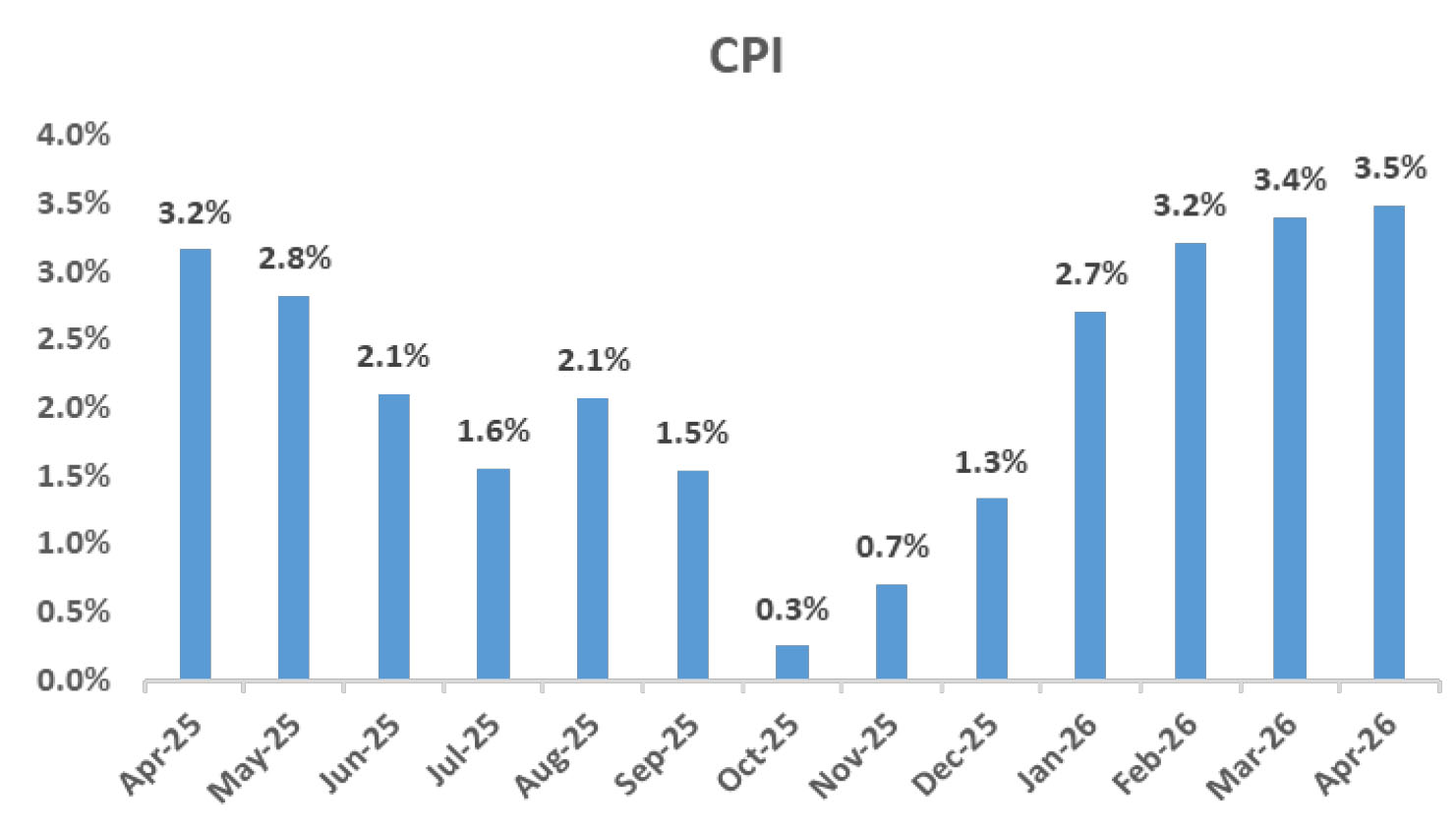
India Macro Developments: Domestic macro indicators reflected a mixed but stable environment, with some emerging external pressures. Trade deficit widened to $28.4bn, reversing the sharp improvement seen earlier of $20.7bn in March. CPI inflation edged up to 3.5% YoY in April from 3.4% in March, remaining relatively benign despite emerging price pressures. India’s WPI inflation surged to a 42-month high of 8.3% YoY in April, compared with 3.9% in March, driven by higher commodity and energy prices. May’s Composite PMI fell to 54.3 (vs 54.7 in Apr); with the Manufacturing flash PMI decreasing to 54.3 from 54.7.
Indian Equities: Indian equities underperformed global peers in May, reflecting both global risk factors and domestic valuation consolidation. MSCI India ($ index) declined ~0.7% in May, underperforming MSCI APxJ/EM indices by 10.4%/10.2% respectively. The Nifty 50 fell ~1.9% and closed May at 23,548. Indian equities performance in May was driven by a betterthan- expected 4QFY26 earnings season and falling crude oil prices, while the key drags were sustained FII outflows due to better value-growth matrix elsewhere in EM/Asia and a severe downgrade in the monsoon forecast for India by IMD. Large caps fell by 1.9%, underperforming small and mid-caps by 4.0%/4.5%, respectively. Materials (+3.7%), Industrials (+3.6%) and Healthcare (+2.2%) were the top performing sectors, while Energy (-6.7%), Staples (-3.7%) and Utilities (-3.6%) were the worst performing sectors.
Currency Movements:The INR remained rangebound over the month and ended the month at 95.00/USD, with a one-year depreciation now at 9.9%. Dollar strength continued to act as a headwind, DXY appreciated by 0.9% in May and ended the month at 98.9. While near-term stability was maintained, the currency remains vulnerable to capital flow volatility and oil price movements.
Bond Yields: In May 2026, the benchmark 10-year G-Sec yield ended close to 7.00%, while the yield curve steepened modestly by 4–5 basis points over the month. Market was volatile as investors reacted to higher crude oil prices, geopolitical tensions in the Middle East, and concerns about inflation.
Global Equities: Global equities advanced in May, but market breadth remained limited, with gains largely driven by AIlinked sectors and select export-driven economies such as Korea and Taiwan. Earnings growth across emerging markets remained robust. The S&P 500 returned ~5%, and the MSCI Emerging Markets Index rose ~9.5%, led by Korea (+35.2%) and Taiwan (+16.5%). The rally gains were strongly skewed toward technology and AI-exposed segments.
Commodities: Commodities remained a key macro transmission channel. Brent crude oil prices dropped by 19.3% in May, following a drop of 3.7% in Apr. Brent currently trades at $93.0, having ended at $114.0/bbl as of end- April.
India Macro Developments: Domestic macro indicators reflected a mixed but stable environment, with some emerging external pressures. Trade deficit widened to $28.4bn, reversing the sharp improvement seen earlier of $20.7bn in March. CPI inflation edged up to 3.5% YoY in April from 3.4% in March, remaining relatively benign despite emerging price pressures. India’s WPI inflation surged to a 42-month high of 8.3% YoY in April, compared with 3.9% in March, driven by higher commodity and energy prices. May’s Composite PMI fell to 54.3 (vs 54.7 in Apr); with the Manufacturing flash PMI decreasing to 54.3 from 54.7.
Indian Equities: Indian equities underperformed global peers in May, reflecting both global risk factors and domestic valuation consolidation. MSCI India ($ index) declined ~0.7% in May, underperforming MSCI APxJ/EM indices by 10.4%/10.2% respectively. The Nifty 50 fell ~1.9% and closed May at 23,548. Indian equities performance in May was driven by a betterthan- expected 4QFY26 earnings season and falling crude oil prices, while the key drags were sustained FII outflows due to better value-growth matrix elsewhere in EM/Asia and a severe downgrade in the monsoon forecast for India by IMD. Large caps fell by 1.9%, underperforming small and mid-caps by 4.0%/4.5%, respectively. Materials (+3.7%), Industrials (+3.6%) and Healthcare (+2.2%) were the top performing sectors, while Energy (-6.7%), Staples (-3.7%) and Utilities (-3.6%) were the worst performing sectors.
Currency Movements:The INR remained rangebound over the month and ended the month at 95.00/USD, with a one-year depreciation now at 9.9%. Dollar strength continued to act as a headwind, DXY appreciated by 0.9% in May and ended the month at 98.9. While near-term stability was maintained, the currency remains vulnerable to capital flow volatility and oil price movements.
Bond Yields: In May 2026, the benchmark 10-year G-Sec yield ended close to 7.00%, while the yield curve steepened modestly by 4–5 basis points over the month. Market was volatile as investors reacted to higher crude oil prices, geopolitical tensions in the Middle East, and concerns about inflation.
Trade: The merchandise trade deficit increased marginally to USD 28.4 billion from USD 27.1 billion in April 2025. India’s total exports (merchandise & services) in FY27 began on a positive note. They rose to USD 80.8 billion in April 2026 from USD 71.1 billion in April 2025, registering a (YoY) growth rate of 13.6%. In April 2026, merchandise exports increased by 13.8% (YoY) to USD 43.6 billion. On the imports side, there was a 10% (YoY) rise in merchandise imports, largely driven by higher imports of gold and silver, which rose by 82% (YoY) and 157% (YoY), respectively. Services trade continued to provide thrust to India’s trade performance. Services exports increased by 13% (YoY), amounting to USD 37.2 billion. Services imports decreased by 1.5% (YoY); as a result, the net of services trade increased by 29.1 per cent (YoY), amounting to USD 20.6 billion. For FY27, the CAD is forecast to average ~2% of GDP, driven by structurally higher energy costs and a wider trade gap.
CPI: Headline CPI came in at 3.5% y/y in April, undershooting expectations and rising only marginally from 3.4% in March. On a sequential basis, CPI rose just 0.1% m/m, a sharp deceleration from the 0.4% m/m increase in March. The softer-thanexpected print was driven by two key factors. First, food prices rose less than anticipated, helped by a muted increase in fruit prices relative to seasonal norms, alongside an outright decline in prices of “other vegetables.” Second, while core-core inflation (ex-precious metals) firmed to 0.3% m/m, from 0.2% in March, the increase fell short of what was expected due to firming PMI prices. On an over-year-ago basis, food inflation ticked up from 3.7% in March to 4.0% in April, while core-core inflation rose modestly to 2.2% y/y from 2.1% y/y.
IMD Monsoon: Upside risks to food inflation: IMD revised down its forecast for the 2026 southwest monsoon to 90% of the Long Period Average, from 92% predicted in April – with a 60% chance of deficient rainfall (less than 90% LPS), with weakness expected to intensify in August–September, raising downside risks given India’s continued reliance on rainfall‑dependent agriculture. Historically, El Niño years have often coincided with weaker monsoons, and the macro sensitivity remains high as rainfed farming covers ~51% of net sown area, produces ~40% of food output, and agriculture supports ~46% of the workforce despite contributing only ~15% of GDP. A rainfall deficit therefore threatens rural incomes and demand, which have only recently begun to recover.
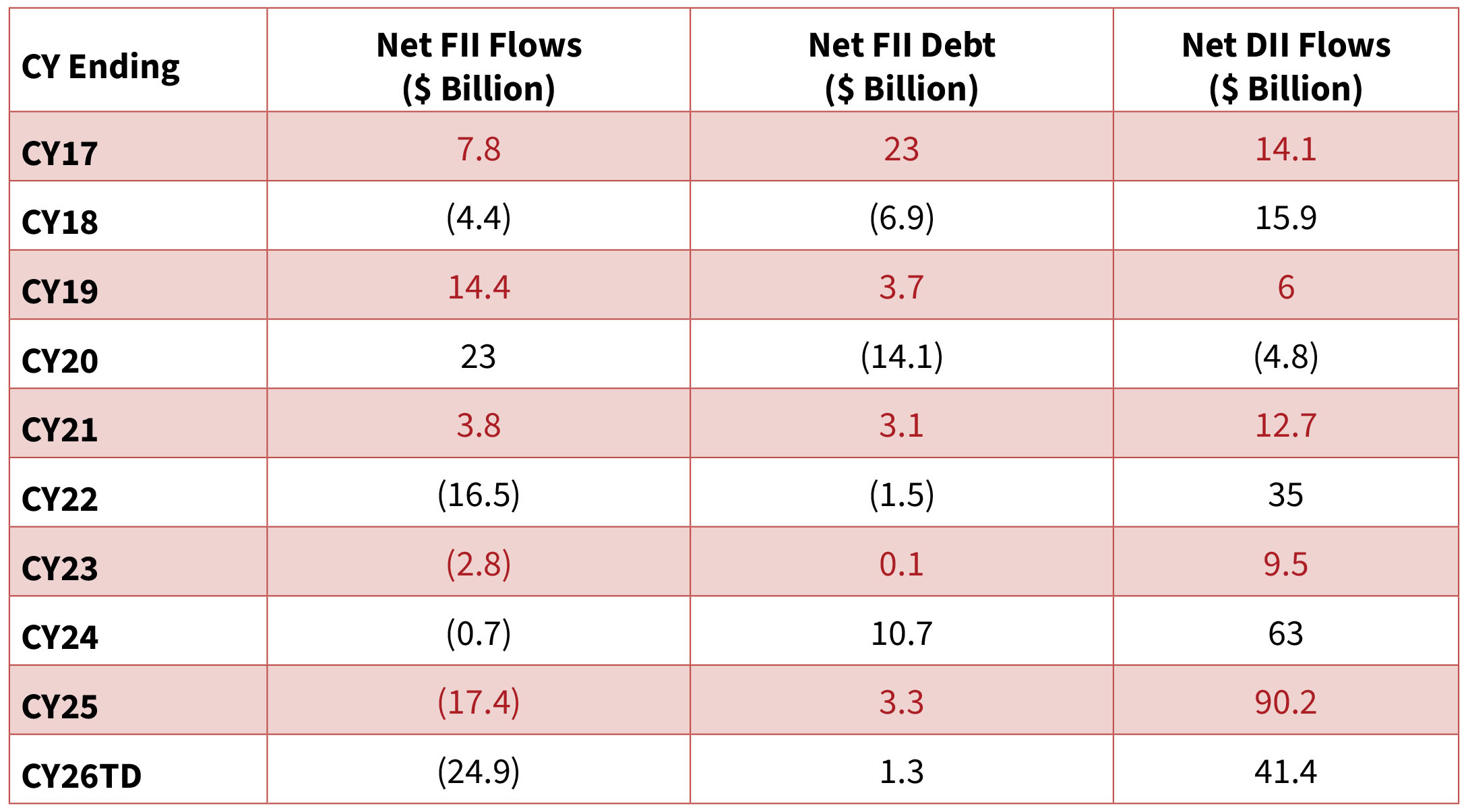
In May 2026, Foreign Institutional Investors (FIIs) maintained their selling trend, with outflows of $4.8bn in May (vs outflows
of $5.2bn in Apr). FIIs bought $0.3bn in the bond market in May (vs selling of $0.4bn in Apr). DIIs remained net buyers for the
34th consecutive month. DIIs continued their inflows at $8.7bn ($5.5bn in Apr). Mutual funds bought $4.6bn (vs $3.3bn in
Apr). Insurance funds and Other FIs were net buyers too, with inflows of +$4.1bn (vs +$2.2bn). Retail net activity remained
flattish (vs inflows of $2.1bn in Apr).