 |  |
Market Outlook
|
AS ON 30TH JANUARY 2026
|


Global Macro Developments: Major central banks held their policy ground in January, consolidating the easing moves of late 2025. The U.S. Federal Reserve kept interest rates unchanged at 3.50%–3.75% on January 28, pausing after its 2025 rate cuts. In the Eurozone, inflation has fallen below the ECB’s 2% goal, allowing the European Central Bank to stay on hold, which is widely seen as having ended its cutting cycle. The Bank of England, which cut rates by 25 bps in December to 3.75%, is expected to keep interest rates unchanged, as inflation rose to 3.4% in December.
Geopolitical developments, however, injected volatility into the macro backdrop. In early January, the U.S. took dramatic action in Venezuela – American forces captured President Nicolás Maduro, jolting Latin American politics and raising questions about regional stability. This move, along with escalating tensions in the Middle East, stoked investor anxiety. On January 13, the White House announced plans for a 25% tariff on any country trading with Iran, a sweeping measure that stirred fears of broader trade conflicts. These geopolitical shocks led to a flight toward safe-haven assets even as global growth remained resilient. On a more positive note, late January brought a win for free trade: India and the European Union finalized a landmark FTA on January 27. Overall, the global economy entered 2026 on a steadier footing with moderating inflation and stable rates, but with new geopolitical curveballs requiring careful navigation.
Global Equities:Emerging Markets extended their remarkable rally – the MSCI EM index jumped about +9% in January (in USD terms), vastly outperforming Developed Markets. Many EM bourses surged to multi-year highs. South Korea’s KOSPI skyrocketed +28% and Brazil’s Bovespa gained +16% for the month, leading global performance. Investors poured into EM assets on hopes of easier monetary policy and a weaker dollar, which traditionally boost emerging economies. In contrast, Developed Market equities saw more modest gains and bouts of volatility. In the U.S., the S&P 500 edged up roughly +1% in January, briefly flirting with record levels before political noise (tariff threats, Fed debates) caused minor pullbacks. Europe’s STOXX 600 rose about +2–3% as improving sentiment and strong corporate earnings in pockets helped offset headwinds.
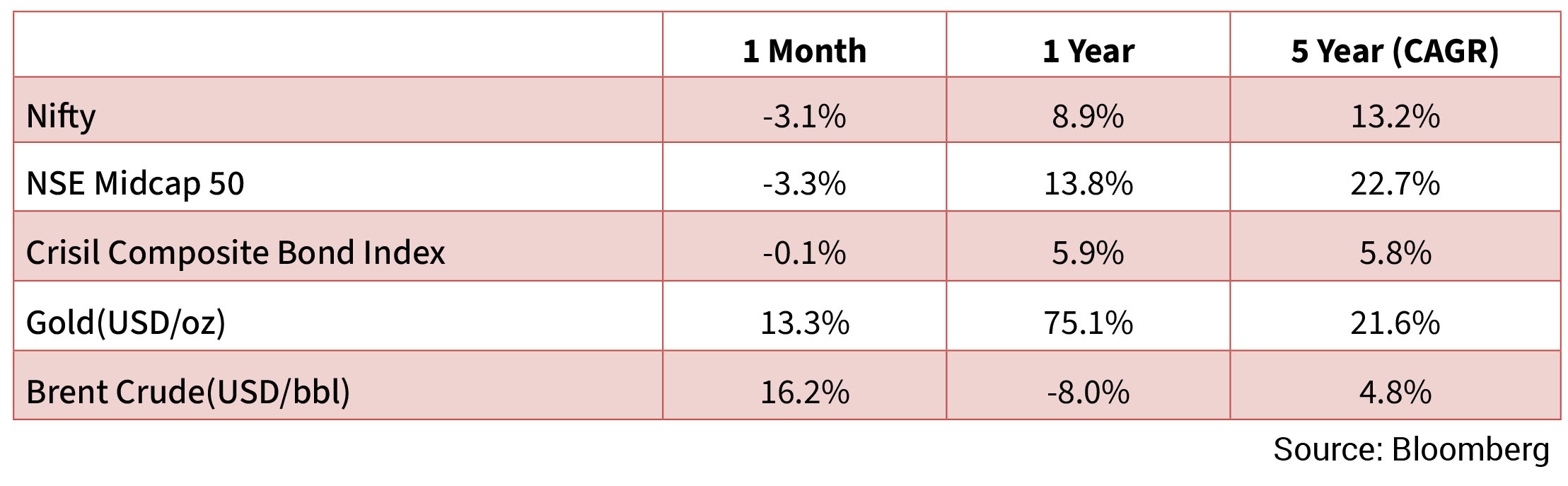
Commodities: Oil prices surged in January, rebounding sharply from their late-2025 lows. Brent crude, which ended 2025 around $62 per barrel, rocketed higher on the back of escalating geopolitical risks and OPEC+ supply signals. By the end of January, Brent was trading near $70, up roughly 16% for the month. The upheaval in Venezuela and US-Iran tensions spurred fears of supply disruptions, just as OPEC+ producers announced a pause on further output increases. This combination of factors tightened the oil market’s outlook, sending energy prices upward. In the precious metals space, gold’s spectacular rally rolled on to new all-time highs. The metal jumped past $4,800/oz in mid-January – a record – as anxious investors sought safety amid global turmoil. Following its ~60% surge in 2025, gold entered 2026 with momentum intact, underpinned by falling real interest rates and central banks diversifying away from the dollar. There was a bout of profit-taking late in the month (gold pulled back slightly from its peak), but it still finished January with solid gains. Silver and other metals tracked a similar pattern: strong early-month rallies to multi-year highs, then some consolidation as traders locked in gains.
India Macro Developments: India’s economy showed continued strength and resilience through the start of the new year. High-frequency indicators remained firmly in expansion mode. The Manufacturing PMI rose to 55.4 in January (from 55.0 in December), indicating a slight acceleration in factory activity on the back of rising new orders. The vast services sector was even more buoyant: the Services PMI climbed to about 59.3 in January (up from 58.0 in December), reflecting robust growth in business activity and demand. Industrial production for December surprised significantly to the upside – output grew 7.8% YoY, beating expectations and marking a second month of very strong expansion. The RBI, in its December review, kept the repo rate unchanged at 6.50% but struck an accommodative tone. Real GDP growth is on positive track with the official Advance Estimate for FY2025-26 pegs full-year growth at 7.4%, up from 6.5% in the prior year. While nominal GDP will be comparatively soft, the overall macro picture for India remains one of high real growth, muted inflation, and supportive policies.
Indian Equities: After a stellar run in 2025, Indian equities faced headwinds in January. The market gave back some gains amid global turbulence and profit-booking. The benchmark Nifty 50 index dropped about 3.1% for the month, closing January at roughly 25,321. The MSCI India USD index fell –5.1%, making India one of the few major markets to post a loss, while most overseas indices were in the green. Notably, mid- and small-cap shares saw a sharper correction than blue chips. Large-cap indices declined ~2.5% in January, but mid-cap and small-cap indexes slumped by about 4–5%, as investors rotated toward safety. Several factors contributed to the weaker performance. First, corporate earnings for Q3 FY26 have been lukewarm so far – roughly half of Nifty companies have met or beaten profit estimates, but there have been notable misses, indicating no broad-based surprise on the upside. Second, foreign investor flows turned decidedly negative again. Third, external uncertainties weighed on sentiment: the U.S. administration’s tariff threats and the stillunresolved U.S.–India trade deal created an overhang. By month-end, some calm returned and the Nifty stabilized in the mid-25,000s, with investors turning focus to India’s Union Budget for the next directional cues.
Currency Movements: The Indian rupee continued to weaken in January, extending the downtrend that began in mid-2025. The INR depreciated roughly 1.5%–2% against the U.S. dollar during the month, moving from ~₹90 per USD at end-2025 to about ₹92 by end- January. The rupee closed January at a new all-time low of ₹91.99/USD. This occurred despite a broadly softer U.S. dollar globally – the DXY index fell another 1.4% in January (and is down over 10% YoY) amid Fed easing and improving risk sentiment. The rupee’s decline, therefore, stands out: over the past year the INR has lost about 5.8% of its value, even as the average EM currency has gained ground. Key factors behind the rupee’s underperformance include India’s large trade deficit and persistent capital outflows. The continuation of foreign equity selling in January kept the rupee on the back foot. Additionally, U.S. trade measures targeting India have weighed on investor sentiment toward the currency. The RBI actively managed the forex market to mitigate volatility.
Bond Yields: Indian bond yields inched up in January, as the market balanced bullish local factors against global and fiscal concerns. The benchmark 10-year G-sec yield ended the month around 6.70%, up from ~6.58% at December’s close. For most of January, yields traded in a relatively tight range near multi-month lows. The bond market grew cautious about the government’s forthcoming borrowing program. Traders braced for the Union Budget to announce record debt issuance for FY2026-27. This supply concern led to a mild sell-off, with the 10-year yield drifting to the upper end of recent trading ranges. Even so, the rise in yields was quite contained – the RBI’s ongoing liquidity support (through open market bond purchases) and India’s still-favorable inflation outlook kept bond investors confident. Globally, bond yields also ticked up modestly: the U.S. 10-year Treasury yield rose to ~4.24% in late January (from ~4.17%). The focus now shifts to the Budget and the RBI’s February policy meeting for fresh cues on the direction of yields.
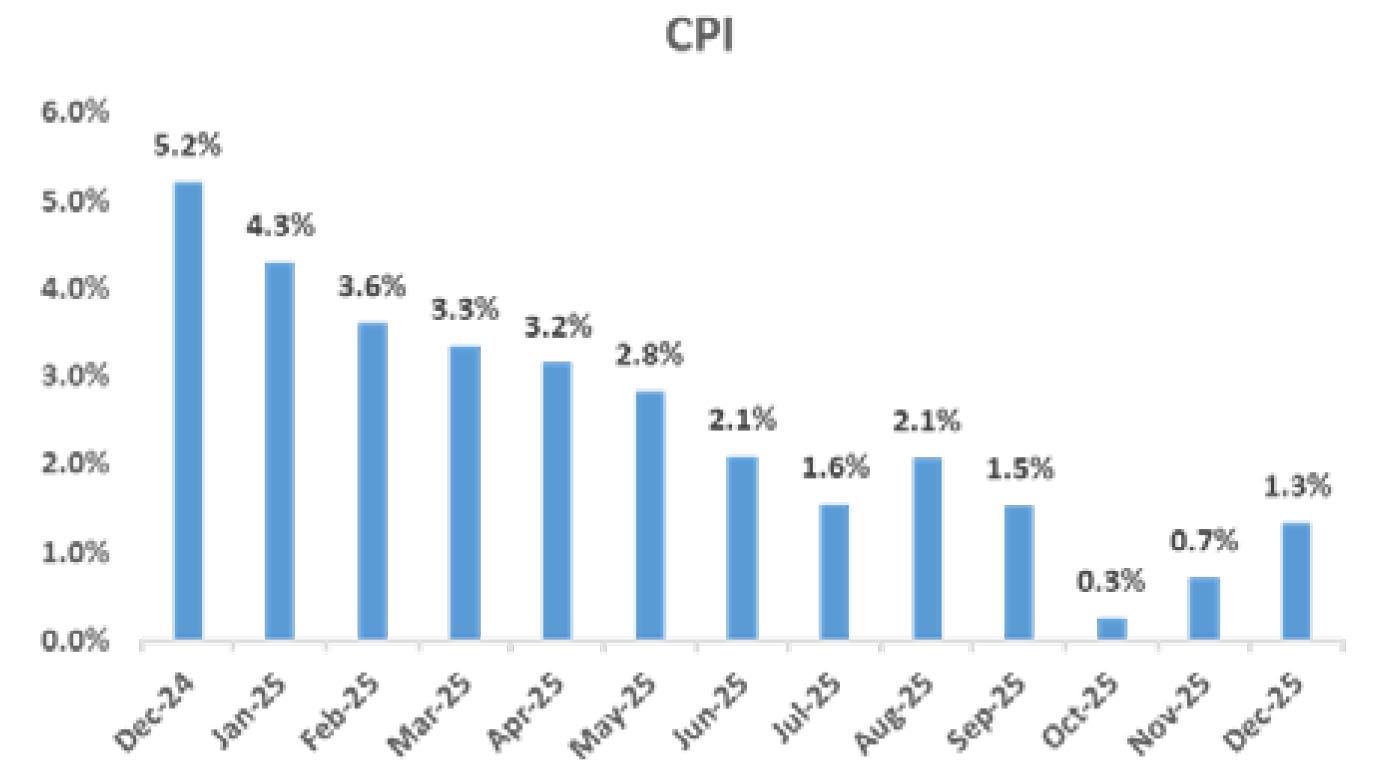
CPI: India’s Headline CPI came in at 1.3% year-on-year in December – the third consecutive month below 2%. While up slightly from
November’s 0.7% and the rock-bottom 0.2% seen in October. The soft reading was primarily due to continued deflation in vegetable
prices. Prices for proteins like eggs and meat firmed up moderately, even as staples like cereals and pulses remained subdued. In
December, core inflation (excluding food and fuel) was running around 4% – roughly at multi-year lows.
Trade:The merchandise trade deficit narrowed to approximately $25 billion in December, virtually the same as November’s $24.5bn gap. The primary driver of this adjustment has been a normalization of imports following the post-monsoon surge. Gold/silver imports plunged to $4.9bn, less than half the prior run-rate. This was an expected mean-reversion after the festive buying spree, likely aided by softer demand as gold prices jumped to record highs. Non-oil, non-gold imports also stabilized, reflecting resilient domestic demand but no further acceleration. On the export side, performance has been surprisingly resilient given global headwinds. Despite the U.S. imposing steep 50% tariffs on certain Indian exports (since mid-2025), India’s overall goods exports have held steady year-over-year. Services exports continue to grow at a healthy clip, thanks to IT and business services demand. With imports easing and exports steady, the current account deficit (CAD) is coming under control.
Trade:The merchandise trade deficit narrowed to approximately $25 billion in December, virtually the same as November’s $24.5bn gap. The primary driver of this adjustment has been a normalization of imports following the post-monsoon surge. Gold/silver imports plunged to $4.9bn, less than half the prior run-rate. This was an expected mean-reversion after the festive buying spree, likely aided by softer demand as gold prices jumped to record highs. Non-oil, non-gold imports also stabilized, reflecting resilient domestic demand but no further acceleration. On the export side, performance has been surprisingly resilient given global headwinds. Despite the U.S. imposing steep 50% tariffs on certain Indian exports (since mid-2025), India’s overall goods exports have held steady year-over-year. Services exports continue to grow at a healthy clip, thanks to IT and business services demand. With imports easing and exports steady, the current account deficit (CAD) is coming under control.
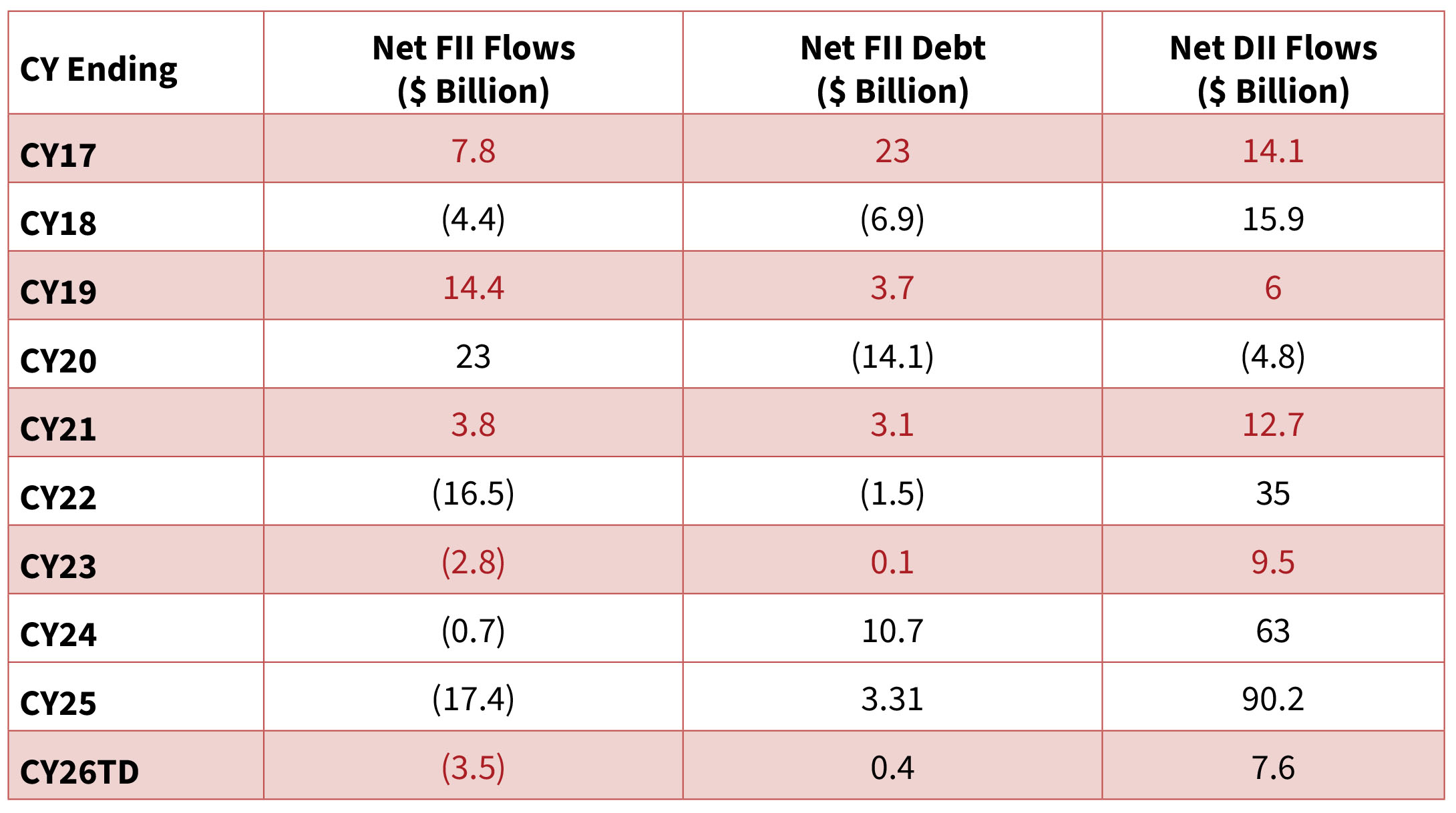
In January 2026, Foreign Institutional Investors (FIIs) continued to be net sellers, offloading $3.5bn in equities (up from
$2.6bn in December), with a noticeable acceleration in the second half of the month. However, domestic investors, including
Domestic Institutional Investors (DIIs), mutual funds, insurance companies, and retail investors, showed strong buying
activity. DIIs remained net buyers for the 30th consecutive month with inflows of $7.6bn (slightly down from December’s
$8.8bn), while mutual funds and insurance funds also saw positive inflows, though slightly lower than the previous month.
Retail investors turned net buyers after four months, contributing $0.2bn, reversing December’s outflow of $1.3bn. In the
bond market, FIIs shifted to net buying with $0.4bn, compared to a $1.3bn sell-off in December.