 |  |
Market Outlook
|
AS ON 27TH FEBRUARY 2026
|


Global Macro Developments: Global macroeconomic landscape remains influenced by elevated policy uncertainty and ongoing geopolitical tensions. Accelerating developments and disruptions associated with artificial intelligence are transforming corporate investment patterns and productivity outlooks, while also adding to market volatility. Escalating tensions in the Middle East have further unsettled global capital markets. Meanwhile, higher crude oil prices have revived upside risks to the global inflation outlook. Uncertainty around U.S. trade policy continues to weigh on sentiment. Nevertheless, the recent U.S. Supreme Court decision regarding the Trump-era tariff measures has offered temporary support to global risk appetite, easing immediate fears of an intensified trade conflict.
Following the Federal Reserve’s decision to keep interest rates unchanged, the FOMC minutes highlighted increasing differences among members regarding the future rate path. With Kevin Warsh expected to assume the role of Fed Chair, the interest rate trajectory in the second half of the year may tilt more dovish, even as the Fed is likely to accelerate the reduction of its balance sheet. In Japan, softer economic growth alongside muted inflation has cast doubt on the pace of further rate hikes. At the same time, mounting concerns over fiscal deterioration have kept pressure on long-term Japanese bond yields. U.S. headline CPI inflation for January 2026 fell to a ten-month low, although core CPI remained relatively sticky. Nonfarm payrolls were robust, supported by strength in healthcare and construction, while the unemployment rate declined to 4.3%. Jobless claims continued to reflect labor market resilience, indicating a cautious hiring and firing approach among employers. Economic estimates also pointed to solid U.S. growth in the third quarter of 2025.
Global Equities:Global equity markets largely extended their gains in February, with Emerging Markets again outperforming Developed Markets. The MSCI EM index climbed ~+5.4% (USD terms) in February, building on January’s strong rally. Many EM bourses surged to fresh highs: South Korea’s KOSPI jumped ~+22% in February, while Taiwan’s market rose ~+13%. In contrast, Developed Market equities saw mixed performance. The MSCI World index was up a modest ~+1.2%; Europe’s STOXX 600 added roughly +3% amid resilient economic data, whereas U.S. equities slipped (~–1% in Feb) as investors digested a higher-for-longer Fed stance and geopolitical noise. China’s market faltered (–5.8% in Feb) on renewed growth concerns and profit-taking after previous gains. By month-end, global equity sentiment remained positive toward emerging markets, supported by a softer dollar and optimism over trade developments, even as U.S. markets took a breather.
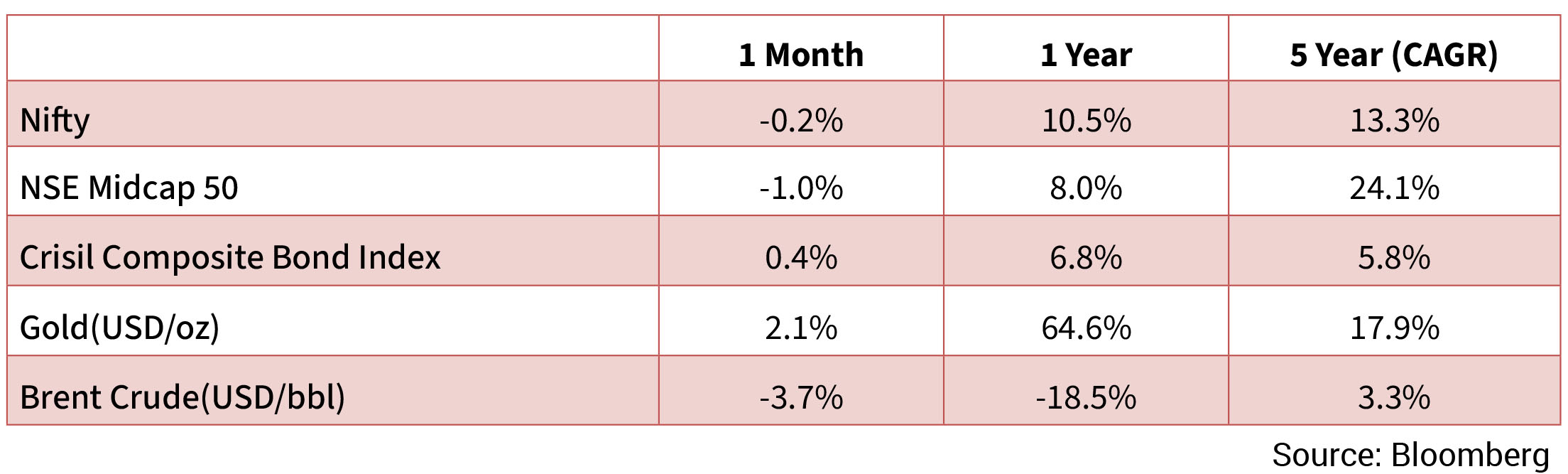
Commodities:Commodity prices moderated in February, consolidating after January’s turbulence. Oil prices, which had rebounded sharply in January, continued its rally ~$73 by end-February, a monthly rise of about 4%. Crude oil and gasoline prices rallied sharply in early March, with crude posting an 8-month high and gasoline posting a 19-month high as the war in Iran entered its fourth day with no sign of de-escalation. In precious metals, gold’s spectacular rally further reached levels above $5,200/oz in February. Base metals were mixed amid a lack of clear demand signals from China.
India Macro Developments:India’s economy demonstrated sustained strength through February. A key development was the revised GDP series released by the government, incorporating updated methodologies. The new data suggest slightly higher recent growth: FY2025-26 real GDP is now estimated to have grown 7.6% (up from 7.4% under the old series). On a quarterly basis, growth appears to have peaked at 8.4% YoY in 3Q 2025, with 4Q 2025 at 7.8%; the implied 1Q 2026 growth is around 7.3%. Average growth over the past three years (FY24–FY26) was revised slightly lower to ~7.3% (CAGR) from 7.7% previously, due to a significant downward revision of FY2023-24 (from 9.2% to 7.2%). High-frequency indicators remained robust. Industrial production (IIP) for January 2026 grew 4.8% yoy, slowing from 8% in December 2025, reflecting broad-based moderation across mining, manufacturing, and electricity. Bank credit growth, at 13.6% YoY, continued to outpace deposit growth of 11.2% YoY. This widening gap has kept the credit-deposit ratio elevated at multi-decade highs. The Manufacturing PMI stayed in the mid-50s, indicating solid expansion, while the Services PMI remained in the high-50s, reflecting buoyant conditions in the services sector. In the sixth bi-monthly monetary policy of FY2025–26, the Monetary Policy Committee (MPC) of the Reserve Bank of India unanimously decided to keep the policy repo rate unchanged, in line with expectations. The MPC marginally revised its projections upward, raising the FY26 growth forecast by 10 basis points to 7.4% and the inflation estimate by 10 basis points to 2.10%.
Indian Equities: After a sharp January correction, Indian equities stabilized in February. February started with Indian Union Budget announcements, which created short term volatility in markets owing to increase of STT on equity market transactions. This was followed by announcement of US lowering trade tariffs on India from 50% to 18%, and signaling a potential Trade deal in future, thereby providing relief to market sentiment, but adding to the volatility. The benchmark Nifty 50 slipped a modest –0.6% and ended the month at ~25,179. Blue-chip large-caps were essentially flat (–0.3%), underperforming midand small-cap shares – mid-caps rose by roughly +2.5–3%, and small-caps by about +0.5–1%. Investors rotated into domestic cyclicals and smaller-cap stocks, which had lagged previously, as risk appetite improved. There was a stark divergence at the sector level. Utilities (+8.0% in February), Healthcare (+7.6%), and Industrials (+6.9%) were the top-performing sectors, buoyed by optimism around government capex and industrial demand. In contrast, Information Technology stocks plunged –18.8% on the month, suffering from global tech headwinds and U.S. tariff concerns. Towards the end of the month though, Geopolitical tensions flared up with US and Israel military action in Iran.
Currency Movements: The Indian rupee strengthened in February, reversing some of its prior weakness. The INR gained ~1.1% against the US dollar, ending February at ₹90.98 per USD. This recovery was aided by returning capital inflows and improved risk sentiment. Even so, on a 12-month basis the rupee remains about 3.8% weaker vs the dollar, having underperformed most emerging market currencies (the EM FX index is up ~+8.4% YoY). The U.S. Dollar Index (DXY) ticked up by 0.6% in Feb (after declining in January) to 97.6, though it remains nearly 9.3% lower than a year ago. India’s improving trade and investment backdrop has helped stabilize the rupee. The Reserve Bank of India continued to actively manage the currency; forex reserves rose in February, with the RBI reportedly buying back over $14 billion of reserves during the month as the rupee strengthened.
Bond Yields: Indian bond yields moved down marginally in February, supported by the benign inflation data and the RBI’s steady policy stance. The 10-year benchmark G-Sec yield closed around 6.66% at end-February, 4 bps lower than end-January. Yields had risen temporarily early in the month in anticipation of heavy government borrowing, but the Union Budget’s fiscal discipline and the RBI’s continued pause on rates reassured bond investors. Bond demand was also bolstered by India’s low inflation environment and the central bank’s commitment to conduct open market operations if needed to contain volatility. In the U.S., 10-year Treasury yields fell sharply by about 30 bps in February to ~3.94%, amid rising expectations that the Fed’s tightening cycle is over. The decline in global yields and India’s favorable macro backdrop (moderate inflation, improved trade outlook) created supportive conditions for Indian bonds. The U.S.–India trade agreement further improved foreign investors’ appetite for Indian debt, potentially aiding capital inflows into bond markets. Early march saw yields spiking up as the war in Iran entered its fourth day with no sign of de-escalation.
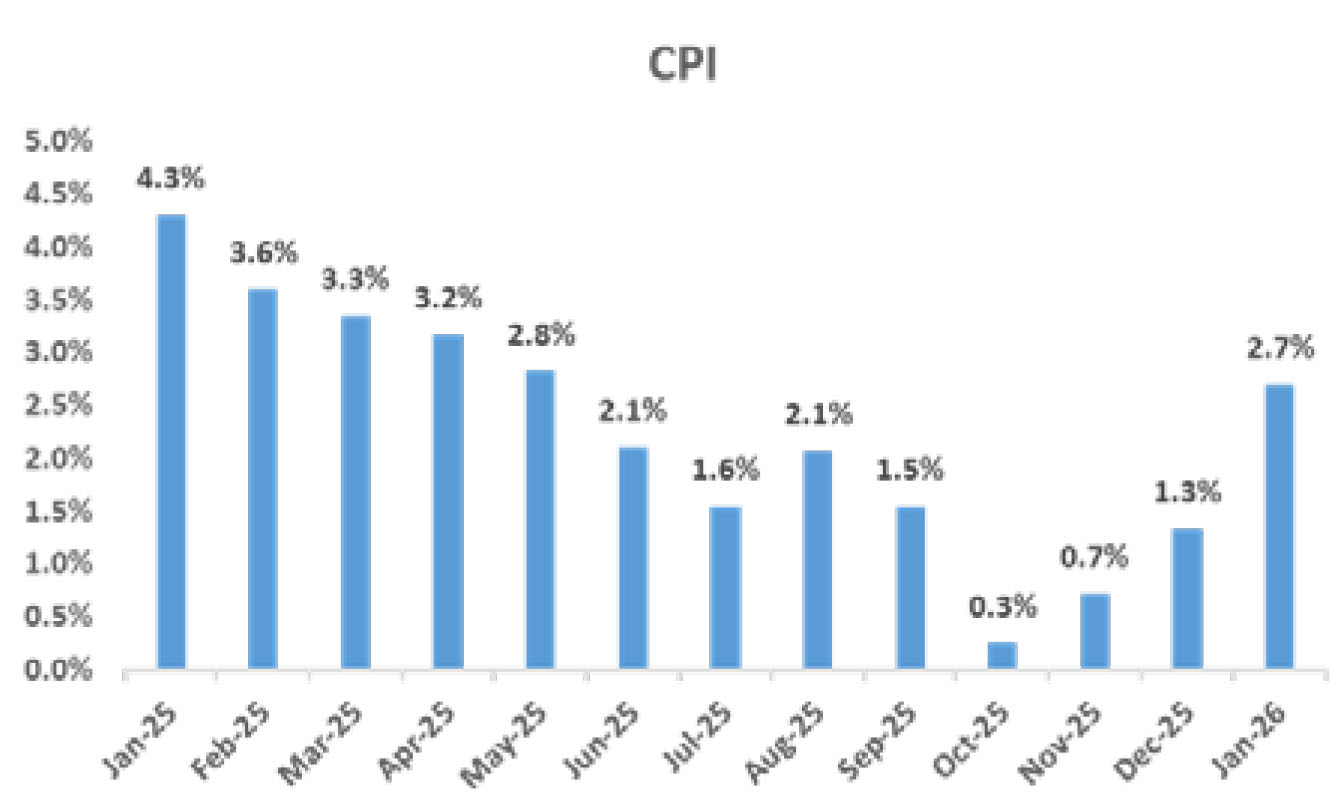
CPI: India’s headline CPI inflation jumped to 2.75% yoy in January 2026 – up from December’s 1.3%. This was the first inflation
print under a newly rebased CPI series, which incorporates updated consumption weights. The slightly higher January
inflation was mainly due to a normalization in food prices and a sharp rise in precious metals prices after exceptionally
soft readings in late 2025. In January, vegetable price deflation eased, and there were notable monthly spikes in gold and
especially silver prices. Even with headline CPI off the lows, underlying price pressures remain muted – core inflation (exfood
and fuel) eased to ~3.4% YoY in January on the new series, reflecting subdued demand-pull pressure. The new CPI
methodology also reduced the weight of food in the index (to 36.8% from ~46% previously), which means food price swings
may have a somewhat smaller impact on the headline figure going forward. India’s WPI inflation rose to 1.80% yoy in
January 2026, up from 0.83% in December 2025. The increase was driven by fading base effects and a firming of food prices,
particularly vegetables.
Trade:India’s merchandise trade deficit widened sharply to USD 35 billion in January 2026, up from USD 25.5 billion in the previous month, primarily driven by a surge in gold imports, which jumped to USD 12 billion from USD 4 billion. As a result, goods imports grew 19% YoY, outpacing the modest expansion in exports. A decline in oil exports by 8.5% YoY further weighed on export growth. Although exports to the U.S. fell 4% month-on-month, FYTD26 exports to the U.S. were 6% higher compared with the same period last year, suggesting limited impact from higher U.S. tariffs. On the services side, India recorded a trade surplus of USD 24 billion, up from a revised USD 22 billion, partially offsetting the widening merchandise deficit. Risks to India’s current account balance include elevated geopolitical tensions, their effect on global oil prices, and pressure on the domestic currency due to foreign portfolio investor (FPI) outflows. However, the U.S.-India trade agreement, which has reduced tariffs, is expected to limit the downside risk.
Trade:India’s merchandise trade deficit widened sharply to USD 35 billion in January 2026, up from USD 25.5 billion in the previous month, primarily driven by a surge in gold imports, which jumped to USD 12 billion from USD 4 billion. As a result, goods imports grew 19% YoY, outpacing the modest expansion in exports. A decline in oil exports by 8.5% YoY further weighed on export growth. Although exports to the U.S. fell 4% month-on-month, FYTD26 exports to the U.S. were 6% higher compared with the same period last year, suggesting limited impact from higher U.S. tariffs. On the services side, India recorded a trade surplus of USD 24 billion, up from a revised USD 22 billion, partially offsetting the widening merchandise deficit. Risks to India’s current account balance include elevated geopolitical tensions, their effect on global oil prices, and pressure on the domestic currency due to foreign portfolio investor (FPI) outflows. However, the U.S.-India trade agreement, which has reduced tariffs, is expected to limit the downside risk.
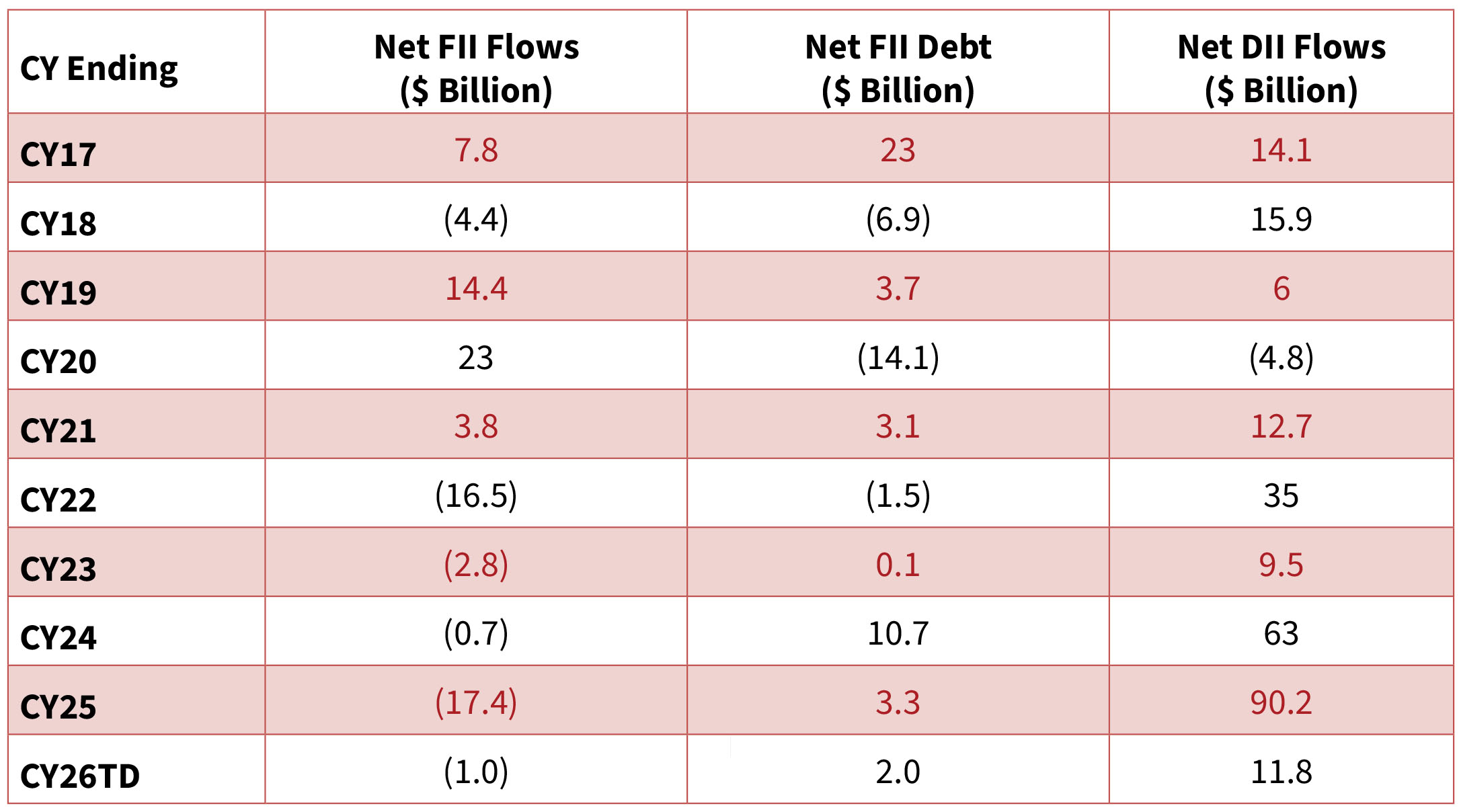
In February 2026, Foreign Institutional Investors (FIIs) turned net buyers, buying $2.3bn in equities (vs selling of $3.3bn in
January). FIIs also bought $1.2bn in the bond market in Feb (vs $0.8bn in Jan). Domestic Institutional Investors (DIIs) showed
strong buying activity. DIIs remained net buyers for the 31st consecutive month with inflows of $4.2bn (down from January’s
$7.6bn), while mutual funds sold $0.5bn (vs buying of $4.7bn in January). Insurance funds and other FIs also saw positive
inflows, higher than the previous month. Retail investors turned net sellers again, contributing $1.2bn, reversing January’s
inflow of $0.5bn.