 |  |
Equity Market Outlook
|
AS ON 27TH FEBRUARY 2026
|


● Government led consumption: The Union Budget FY26 has materially boosted household disposable income through income tax relief, with no tax payable up to Rs12 lakh and an estimated ~Rs1 lakh crore direct tax benefit to consumers. Alongside this, GST rate rationalisation across several mass consumption categories is expected to lower effective prices and support demand recovery. Private consumption, which accounts for majority of India’s GDP, is expected to remain the key growth driver next year.
● GST collections validate consumption resilience: February 2026 gross GST collections stood at Rs1.83 lakh crore, up 8.1% YoY, despite recent rate cuts, indicating that higher volumes and better compliance are offsetting lower tax rates. Net GST collections grew 7.9% YoY to Rs1.61 lakh crore, while cumulative GST collections for FY26 (till Feb) reached Rs20.27 lakh crore (+8.3% YoY).
● Revival in credit growth supports GDP momentum: Bank credit growth has re accelerated to ~13.6–14.6% YoY in early 2026, materially above deposit growth, reflecting improving economic activity and capex pipeline visibility. RBI data indicates stronger traction in corporate loans, retail credit and infrastructure linked segments, which historically has a positive multiplier effect on GDP growth and earnings. Sustained credit expansion remains a key support for medium term growth.
● Global: uncertainty remains a near term overhang. Ongoing geopolitical tensions, particularly the Iran–Israel conflict, have led to a sharp spike in crude oil prices, with Brent recently trading in the above 80/bbl range and risk scenarios indicating potential upside in case of supply disruption through the Strait of Hormuz. Higher crude prices pose near term risks to inflation, macros and market sentiment, keeping volatility elevated despite strong domestic fundamentals.
● US–India trade deal is an incremental structural positive: The recently announced US–India trade framework includes a reduction in US tariffs on Indian goods to 18%, removal of additional punitive duties, and improved market access across textiles, engineering goods, pharmaceuticals and technology linked sectors. The deal is expected to support exports, strengthen manufacturing competitiveness and improve medium term earnings visibility for select sectors, partially offsetting global headwinds.
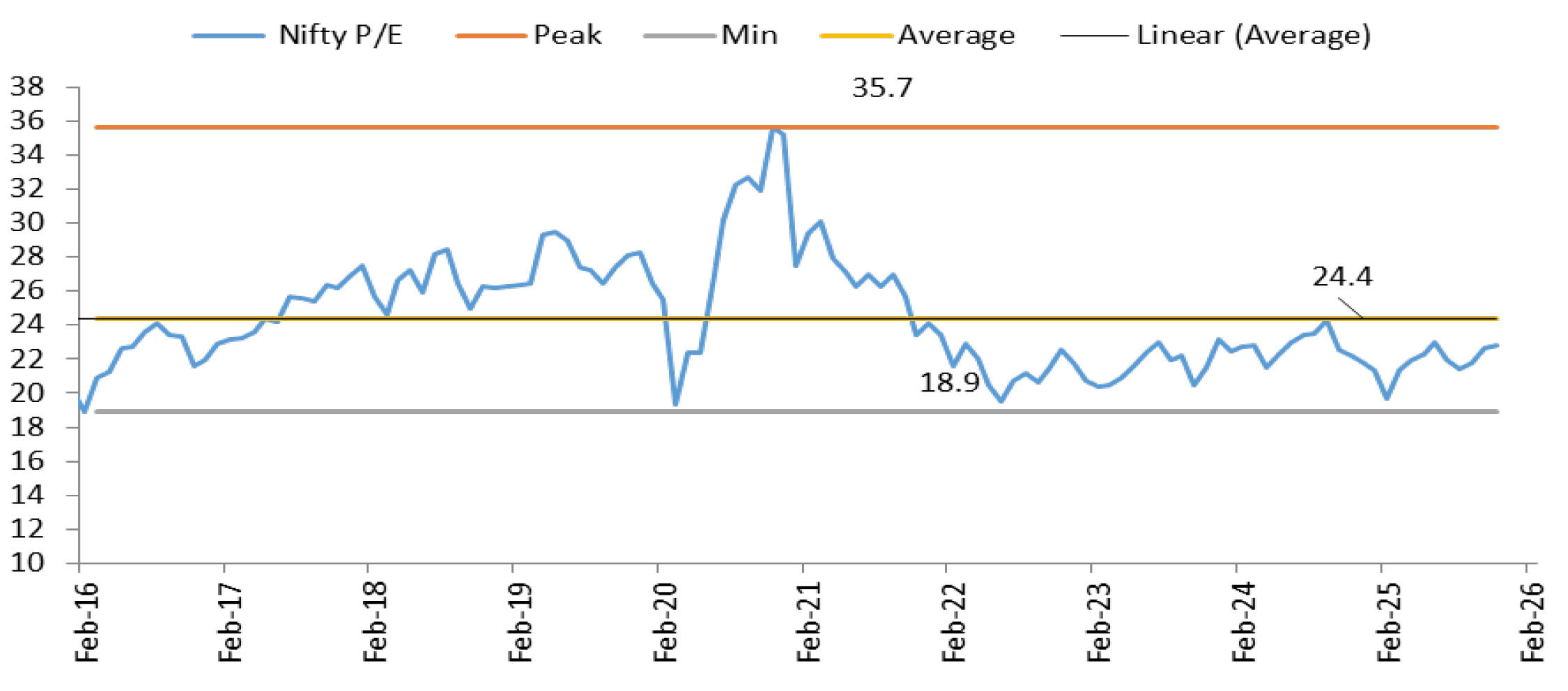
● Outlook – near term volatility, constructive medium to long term: While global uncertainties, geopolitical risks and commodity volatility may drive intermittent corrections in the near term, domestic growth levers—policy led consumption support, healthy GST collections, improving credit growth and structural trade tailwinds—remain firmly in place. Overall, we remain positive on equities over the medium to long term, with market volatility offering opportunities for calibrated allocation rather than a reason to turn cautious.
