 |  |
Market Outlook
|
AS ON 30TH APRIL 2026
|


Global Macro Developments: April marked a clear risk-on rebound in global markets after the US–Iran ceasefire
announcement, even as Strait of Hormuz disruption and elevated energy prices kept the macro backdrop fragile. Global
equities rallied strongly, led by AI-linked segments and parts of EM Asia. In India, equities participated but lagged broader
EM/APxJ; within India, mid/small caps outperformed large caps, and sector leadership was concentrated in Real Estate /
Industrials / Utilities. On domestic macro, RBI held rates at 5.25%, and data prints were mixed but broadly resilient. Bond
markets saw some relief with yields easing in April, but the 10-Y G-Sec yield closed above 7% for the second consecutive
month.
In the US, the Federal Reserve maintained the policy range at 3.50%–3.75%, reinforcing a “wait-and-watch” stance as inflation risks from the conflict complicated the easing path. Credit markets and risk assets behaved as if the conflict risk was fading, but rates markets remained more sensitive to inflation/fiscal concerns—highlighting ongoing cross-asset divergence.
Global Equities: Global equities delivered a sharp rebound in April, driven by a decisive rotation back into growth/AI themes. The S&P 500 returned ~10.5%, and the MSCI Emerging Markets Index rose ~14.7%, led by Taiwan (+26.2%) and South Korea (+38.2%) (AI supply-chain beneficiaries). The rally breadth improved versus March, with small caps also participating, though gains were strongly skewed toward technology and AI-exposed segments.
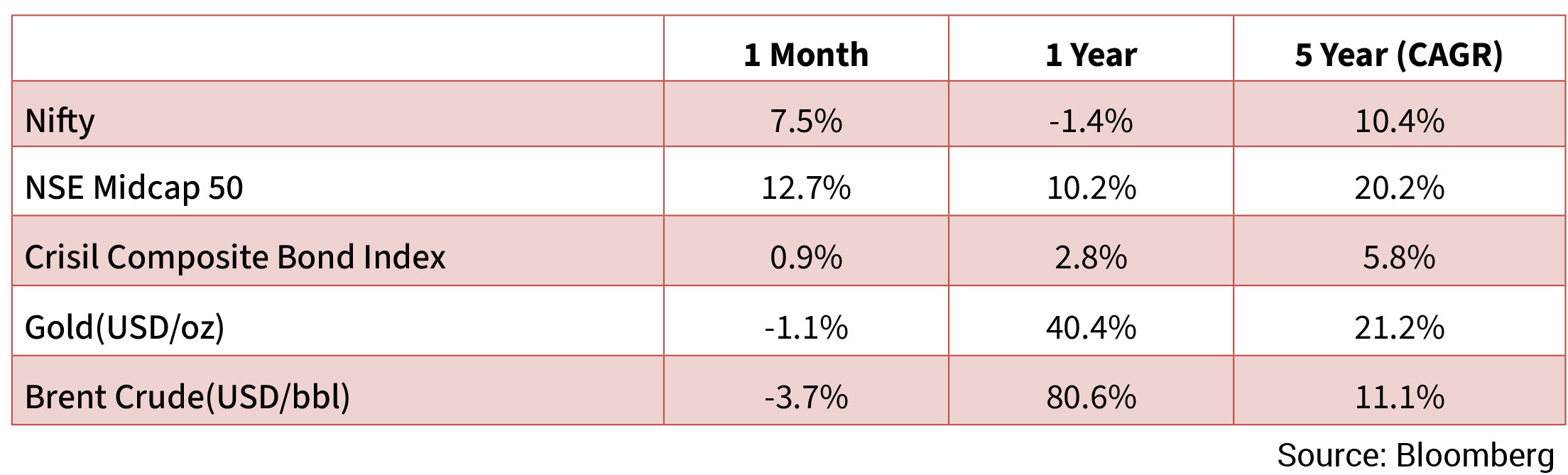
Commodities: Commodities remained a key macro transmission channel. In April, the broad complex gained ~4.2%, led by energy (+7.7%) and industrial metals (+5.0%), reflecting both conflict-related supply uncertainty and AI-driven demand for real-world buildout materials. Brent crude remained elevated and at times above $110/bbl, keeping inflation expectations and policy uncertainty in focus.
India Macro Developments: India’s April macro messaging remained anchored by policy stability and a mixed-but-resilient data flow. The RBI MPC voted unanimously to hold the repo rate at 5.25% and maintained a neutral tone. External balances improved at the margin: the trade deficit narrowed to a nine‑month low of $20.7bn in March (reported during April), from $27.1bn in February. Inflation ticked up but stayed contained: March CPI printed at 3.4% YoY (vs 3.2% in Feb). Activity indicators were supportive: March IP rose 4.1% YoY, and April Composite PMI rose to 58.3 with Manufacturing PMI at 55.9 (flash), up from March levels.
On rates and funding supply, the April policy/borrowings narrative helped sentiment: the government’s H1FY27 borrowing plan was seen as lower than expectations, with the share of long bonds reduced to ~25% (vs ~35% in 1H last year), supporting curve flattening dynamics.
Indian Equities: Indian equities rose in April alongside the global recovery, but underperformed regional peers. MSCI India ($ index) gained +9.1% in April, yet lagged MSCI APxJ / MSCI EM. The Nifty 50 rose +7.5% and closed April at 23,998. Style leadership favored smaller caps: large caps rose +8.3%, while small and mid caps outperformed large caps by ~7.4% and ~4.2%, respectively. Sector performance was highly polarized. IT was the only sector to end the month in the red (-0.7%), while cyclicals/interest-rate sensitives led: Real Estate (+21.4%), Industrials (+17.0%), and Utilities (+14.8%) were the top performers.
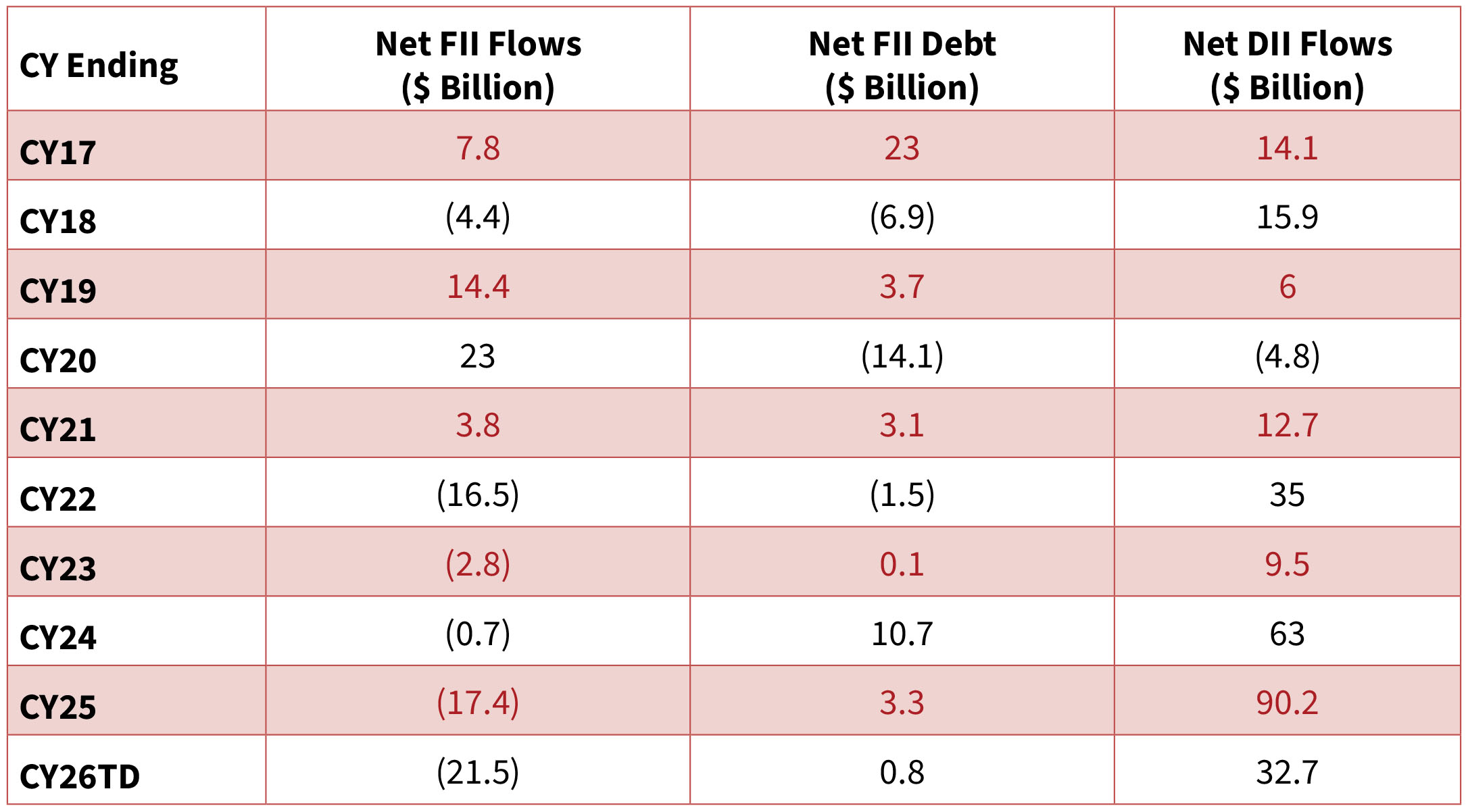
Flows continued to show the familiar push-pull. FIIs remained net sellers with ~$5.2bn outflows in April (lower than ~$14.2bn outflows in March), while DIIs recorded ~$5.5bn inflows (vs ~$15.4bn in March). Retail buying also improved to ~$1.9bn in April (vs ~$0.2bn in March).
Currency Movements:The INR stabilized in April after March’s sharp move. INR depreciation was ~0.1% in April, ending the month at 94.92/USD.
Bond Yields: In April 2026, Indian government bond yields eased from March highs, supported by a combination of geopolitical de‑escalation after the US–Iran ceasefire, RBI’s steady policy stance, and a favourable borrowing calendar. The 10‑year G‑Sec yield closed ~7.02% in April, while the 30‑year yield softened to ~7.55%, leading to a modest flattening of the curve, with the 10Y–30Y spread compressing from ~70+ bps in March to ~58–60 bps. Lower-than-expected 1HFY27 government borrowing, particularly reduced long‑end supply, helped anchor long‑duration yields despite elevated global crude prices. Overall, bond markets reflected tactical relief and improved supply dynamics, though upside risks to yields from oil prices, inflation and external volatility remained in focus.
In the US, the Federal Reserve maintained the policy range at 3.50%–3.75%, reinforcing a “wait-and-watch” stance as inflation risks from the conflict complicated the easing path. Credit markets and risk assets behaved as if the conflict risk was fading, but rates markets remained more sensitive to inflation/fiscal concerns—highlighting ongoing cross-asset divergence.
Global Equities: Global equities delivered a sharp rebound in April, driven by a decisive rotation back into growth/AI themes. The S&P 500 returned ~10.5%, and the MSCI Emerging Markets Index rose ~14.7%, led by Taiwan (+26.2%) and South Korea (+38.2%) (AI supply-chain beneficiaries). The rally breadth improved versus March, with small caps also participating, though gains were strongly skewed toward technology and AI-exposed segments.
Commodities: Commodities remained a key macro transmission channel. In April, the broad complex gained ~4.2%, led by energy (+7.7%) and industrial metals (+5.0%), reflecting both conflict-related supply uncertainty and AI-driven demand for real-world buildout materials. Brent crude remained elevated and at times above $110/bbl, keeping inflation expectations and policy uncertainty in focus.
India Macro Developments: India’s April macro messaging remained anchored by policy stability and a mixed-but-resilient data flow. The RBI MPC voted unanimously to hold the repo rate at 5.25% and maintained a neutral tone. External balances improved at the margin: the trade deficit narrowed to a nine‑month low of $20.7bn in March (reported during April), from $27.1bn in February. Inflation ticked up but stayed contained: March CPI printed at 3.4% YoY (vs 3.2% in Feb). Activity indicators were supportive: March IP rose 4.1% YoY, and April Composite PMI rose to 58.3 with Manufacturing PMI at 55.9 (flash), up from March levels.
On rates and funding supply, the April policy/borrowings narrative helped sentiment: the government’s H1FY27 borrowing plan was seen as lower than expectations, with the share of long bonds reduced to ~25% (vs ~35% in 1H last year), supporting curve flattening dynamics.
Indian Equities: Indian equities rose in April alongside the global recovery, but underperformed regional peers. MSCI India ($ index) gained +9.1% in April, yet lagged MSCI APxJ / MSCI EM. The Nifty 50 rose +7.5% and closed April at 23,998. Style leadership favored smaller caps: large caps rose +8.3%, while small and mid caps outperformed large caps by ~7.4% and ~4.2%, respectively. Sector performance was highly polarized. IT was the only sector to end the month in the red (-0.7%), while cyclicals/interest-rate sensitives led: Real Estate (+21.4%), Industrials (+17.0%), and Utilities (+14.8%) were the top performers.
Flows continued to show the familiar push-pull. FIIs remained net sellers with ~$5.2bn outflows in April (lower than ~$14.2bn outflows in March), while DIIs recorded ~$5.5bn inflows (vs ~$15.4bn in March). Retail buying also improved to ~$1.9bn in April (vs ~$0.2bn in March).
Currency Movements:The INR stabilized in April after March’s sharp move. INR depreciation was ~0.1% in April, ending the month at 94.92/USD.
Bond Yields: In April 2026, Indian government bond yields eased from March highs, supported by a combination of geopolitical de‑escalation after the US–Iran ceasefire, RBI’s steady policy stance, and a favourable borrowing calendar. The 10‑year G‑Sec yield closed ~7.02% in April, while the 30‑year yield softened to ~7.55%, leading to a modest flattening of the curve, with the 10Y–30Y spread compressing from ~70+ bps in March to ~58–60 bps. Lower-than-expected 1HFY27 government borrowing, particularly reduced long‑end supply, helped anchor long‑duration yields despite elevated global crude prices. Overall, bond markets reflected tactical relief and improved supply dynamics, though upside risks to yields from oil prices, inflation and external volatility remained in focus.
Trade: India’s merchandise trade deficit in March narrowed sharply to a nine‑month low of $20.7bn, well below the consensus estimate of $28.5bn, reflecting largely one‑off factors such as trade disruptions linked to the Middle East conflict and lags in the pass‑through of higher energy prices into import data. As these temporary effects fade and elevated energy prices feed through more fully, the trade deficit is expected to widen materially in the coming months. For FY27, the CAD is forecast to average ~2% of GDP, driven by structurally higher energy costs and a wider trade gap.
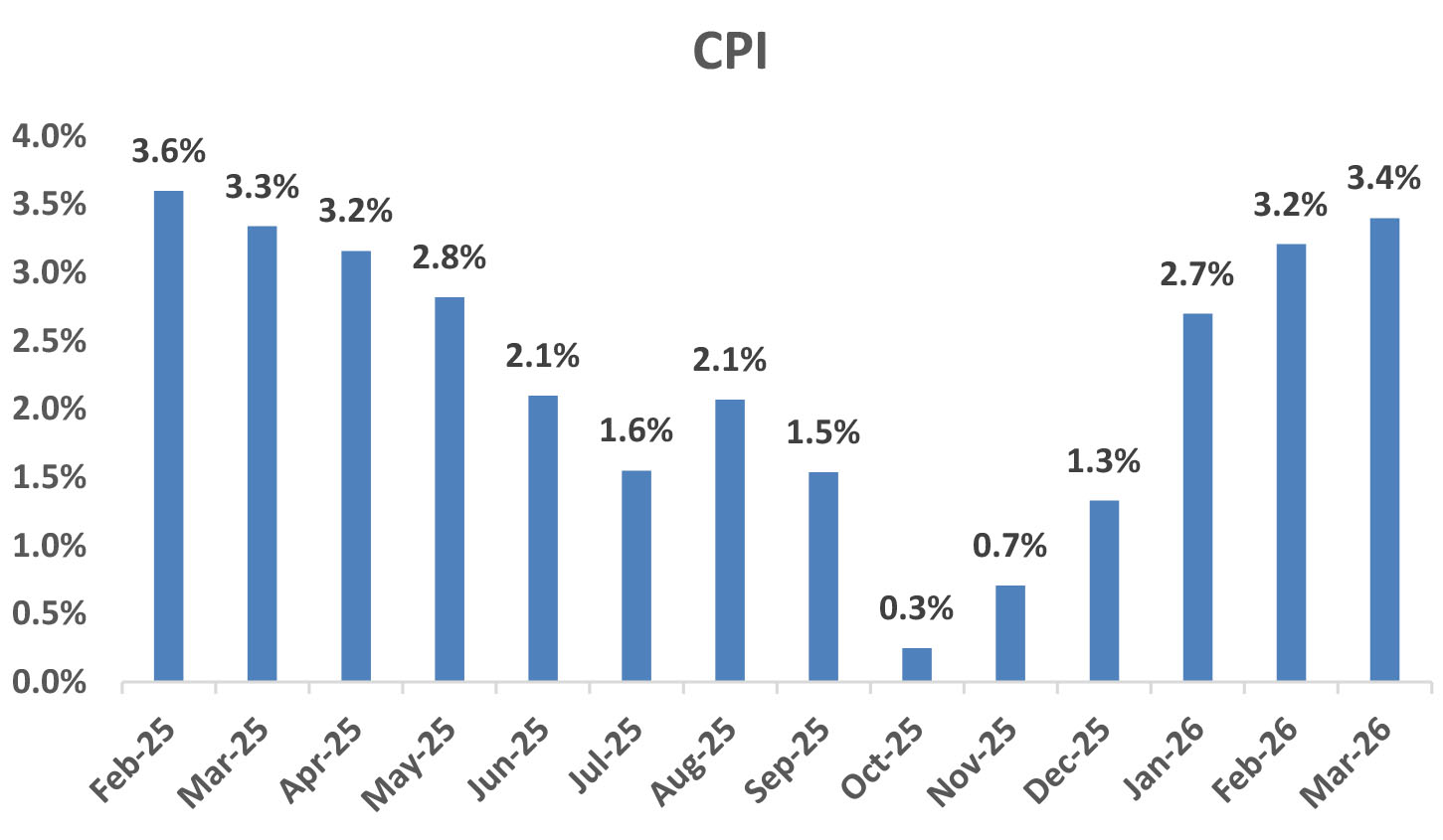
CPI: Headline CPI inflation in March came in broadly around expectations at 3.4% y/y, up from 3.2% in February. On a sequential basis, headline CPI increased 0.4% m/m moderating from a 0.5% m/m rise in February. The pass‑through from the oil and gas price shock into March inflation remained limited and largely confined to fuel components. Fuel prices rose 1.5% m/m (non‑seasonally adjusted) in March, compared with an average decline of 0.1% m/m over the previous two months, driven primarily by higher LPG and coal prices. In contrast, core‑core inflation (core CPI excluding petrol, diesel and precious metals) remained benign at 0.2% m/m in March, unchanged from February. On a year‑on‑year basis, core‑core inflation was steady at 2.1%, indicating that firms have not yet meaningfully passed through higher petroleum‑linked input costs to consumers.
IMD Monsoon: Upside risks to food inflation: IMD’s first‑stage forecast indicates the 2026 southwest monsoon at 92% of the Long Period Average, with weakness expected to intensify in August–September, raising downside risks given India’s continued reliance on rainfall‑dependent agriculture. Historically, El Niño years have often coincided with weaker monsoons, and the macro sensitivity remains high as rainfed farming covers ~51% of net sown area, produces ~40% of food output, and agriculture supports ~46% of the workforce despite contributing only ~15% of GDP. A rainfall deficit therefore threatens rural incomes and demand, which have only recently begun to recover.
MPC: India’s MPC unanimously held policy rates and maintained a neutral stance, defying market expectations of a hawkish pivot, even as it slightly revised down growth and marked up inflation. Average inflation for H1FY27 was nudged to 4.2%, while full‑year inflation is projected at 4.6%, reflecting elevated energy prices and unfavourable base effects later in the year. The policy also highlights downside growth and upside inflation risks from higher crude prices—with sensitivity showing $95/bbl crude in FY27 lowering growth to 6.7% and lifting CPI to 5.0%—and from a potential super El Niño that could pressure food prices.
In March 2026, Foreign Institutional Investors (FIIs) turned net sellers, selling $13.3bn in equities (vs buying of $1.7bn in
February). FIIs also sold $0.7bn in the bond market in March (vs $1.3bn buying in Feb). DIIs remained net buyers for the 32nd
consecutive month with inflows of $15.4bn (vs Febraury’s $4.2bn), while mutual funds bought $8.1bn (vs buying of $1.3bn
in Feb). Insurance funds and other FIs also saw positive inflows, higher than the previous month. Retail investors turned
marginal buyers again, contributing $0.4bn, reversing Febraury’s outflow of $1.1bn.